
8 content problems in the media & entertainment industry, solved

The biggest content problems in the media & entertainment industry are content overload, scattered storage, slow search, manual production work, unclear image rights, and a growing struggle to prove that an image is real. A Digital Asset Management (DAM) system solves them by giving every asset one governed home, rich metadata, automated workflows, and a verifiable provenance record across its entire lifecycle.
What are the biggest content problems in the media & entertainment industry?
The biggest content problems in the media & entertainment industry come down to volume, control, and trust. Teams handle too many files in too many places, with too little information attached, while generative AI adds volume and doubt.
|
Problem |
What it costs you |
How a DAM solves it |
|
1. Content overload and too many formats |
Slow selection, missed deadlines |
Central library, culling tools, metadata |
|
2. Content scattered across storage and sharing tools |
Duplicates, lost files, brand inconsistency |
One single source of truth |
|
3. You can't find what you need |
Hours lost searching, content recreated |
Metadata search and AI auto-tagging |
|
4. Time-consuming manual tasks |
Bottlenecks in production |
Metadata-driven workflow automation |
|
5. Collaboration bottlenecks |
Delays, slow approvals |
Shared access, approval workflows, integrations |
|
6. Unclear image rights and licenses |
Copyright claims and fines |
Rights metadata, visual markers, consent linking |
|
7. Proving content authenticity |
Loss of audience trust |
C2PA support and provenance tracking |
|
8. A fragmented content lifecycle |
Slow, inconsistent distribution |
DAM as the hub of an integrated content ecosystem |
A Digital Asset Management system is software that stores, organizes, governs, and distributes digital assets such as images, videos, graphics, audio, and documents. Its power comes from metadata: information attached to each file that describes what it is, who made it, and how it may be used.
1. Content overload: too many files, too many formats
Content overload is a problem because volume grows faster than a team's ability to sort, select, and publish. Print, web, social, and video channels all need their own content, in formats ranging from JPEG to MPEG, TIFF to GIF, and PSD to PDF.
Generative AI has added fuel to this content explosion. Image variations, social cuts, illustrations, and translated versions can now be produced in minutes, so a single story can quickly create dozens of new files. AI-generated content also needs clear labels, so no one confuses it with original photography.
How DAM solves content overload
A DAM gives every format one central home, configured to your workflows. Metadata management and fast culling and selection tools let picture desks move through thousands of frames quickly and pass on only the best shots.
2. Scattered content across storage and sharing tools
When content lives in too many places, nobody knows which file is the right one. Hard drives hold this, cloud platforms like Dropbox, Google Drive, or SharePoint hold that, and local storage holds those. Sharing makes it worse: email, Slack, and WeTransfer scatter files further with every upload and download.
Have you ever been asked where to find "those photos" or "that PDF"? Annoying, isn't it? It also puts brand consistency at risk.
How DAM centralizes content storage and sharing
A DAM becomes the single source of truth for approved content, shared through controlled links and portals. Digital Asset Management versus cloud storage is not an either-or choice: many teams keep cloud storage for work in progress and the DAM for finished assets.
3. Slow search and buried media archives
Teams can't find files because folder structures depend on people remembering file names, dates, and naming conventions. In a newsroom, that has a real price: if the right photo takes ten minutes to find, a weaker image often gets published instead.
Even tagged content can be hard to find. One editor tags "PM", another "prime minister", a third uses the person's name. Without a shared vocabulary, search results are incomplete and people stop trusting search.
The bigger loss is the archive: years of photography that could be reused or licensed stay buried, and teams recreate content they already own.
How DAM makes every asset searchable
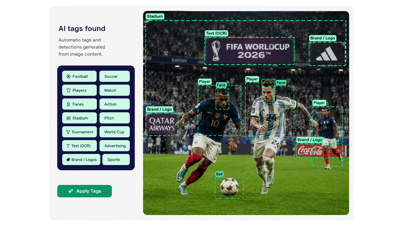 A DAM replaces folder hunting with metadata search, so you can filter by subject, photographer, date, event, or rights status. Controlled vocabularies keep tagging consistent. AI auto-tagging adds keywords to new files automatically, in multiple languages, and text recognition makes text inside images searchable. AI assists, but people still decide what gets published.
4. Manual tasks that slow down media workflows
Manual tasks slow down workflows because every file needs to be handled by a person before it can move on. Teams often handle color correction, resizing, format and color space conversion, ICC profile tagging, output DPI settings, and approvals by hand.
The pressure peaks at big moments. During a sports final or an election night, photographers can deliver thousands of frames per hour, each needing captions, credits, and the right format. Photo editors end up renaming files and retyping copyright notices instead of choosing the shots that tell the story.
How DAM automates media workflows
Digital Asset Management workflows automate these steps using the metadata already in each file. Fotoware Flow, for example, is a cloud-native automation engine that lets teams design, run, and monitor metadata-driven workflows visually, without code. Files can be tagged, converted, and routed to the right editor automatically, and rules check whether rights are valid before sending an asset to publication or to a review queue. In Fotostation, metadata macros add credits and copyright notices on upload.
Free eBook
5 essential DAM workflows
A guide to Digital Asset Management workflows that enhance efficiency, collaboration, and compliance.
Free Guide
Close the Content Provenance Gap
See where Content Credentials can be lost across the image lifecycle and how DAM can help preserve provenance from capture to publication.
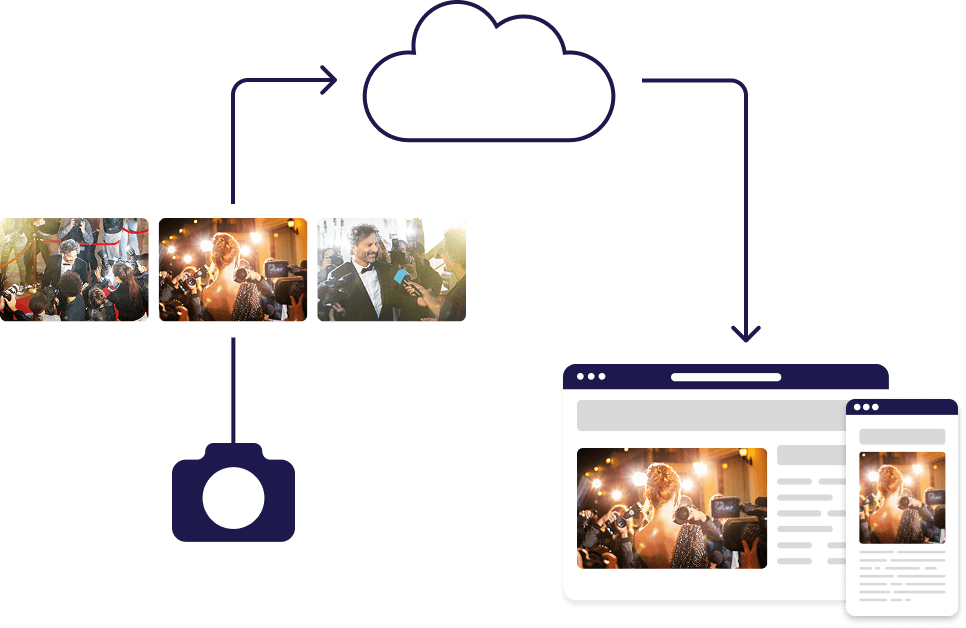
Webinar
Content Ownership: From Theory to Value
Turn trusted content into lasting value Learn how media organizations protect content ownership, prove authenticity, and create new value from their archives in the age of AI.

On this page