
EU AI Act Article 50 explained: labeling AI-generated content

Visible vs. machine-readable disclosure
Article 50 works on two levels at once, and the difference needs to be understood.
The first is machine-readable marking: a signal carried inside the file so platforms, feeds, and search systems can recognize AI involvement automatically, with no human in the loop.
The second is visible disclosure, a note a viewer can actually see. That second layer is expected mainly where synthetic media could be mistaken for reality, or where AI-written text speaks to matters of public interest.
Depending on the asset, one or both may be relevant.
What Article 50 means for organizations and individuals
The obligations do not fall on everyone equally. The Act frames them around two roles – provider and deployer - and knowing which one you occupy is the first step to understanding what applies. If you are a private individual, different rules apply.
A provider is the party that builds a generative AI system and places it on the market, such as the company behind an image generator or a language model. Providers carry most of the machine-readable side. They are expected to mark their systems' outputs so AI involvement can be detected automatically, which is why several tools already embed that signal at the moment of generation.
 A deployer is an organization or person that uses such a system under its own authority in a professional context. This is where most marketing, communications, and media teams sit, even when they had no part in building the tool. Using an AI system in the course of your professional activities is enough to make you a deployer, and with that come the visible-disclosure duties: generated deepfakes must be recognizable as such, with an exception where they are clearly part of art, satire, or similar. Published text on matters of public interest must indicate that it is AI-generated or manipulated, unless a person has reviewed it and taken editorial responsibility for it.
| Provider | Deployer | |
| Who | Builds the AI system and puts it on the market | Uses AI tools professionally, most marketing and communication teams |
| Main Duty | Machine-readable marking embedded in the output | Visible disclosure for realistic deepfakes and unreviews public-interest text |
| Example | The company behind an image generator | A brand producing campaign visuals with AI |
Table: Who has to do what for the EU AI Act Article 50?
Individuals are treated differently. People who use an AI system solely for personal, non-professional purposes fall outside the deployer definition, and the transparency duties do not attach to them. The line is drawn at use under your own authority in a professional setting, not at whether you personally pressed the button.
The practical read for a content team is that you are almost certainly a deployer, but where there is doubt if a specific piece of content falls under Article 50 is a question worth putting to your legal team.
What types of content are covered by the EU AI Act Art. 50?
The obligations turn less on which tool was used and more on how the result is presented to an audience. Broadly, two families of content are in scope: media that imitates reality, such as a synthetic voice in an advert, an AI-altered background in a news photo, or a face-swapped video; and automated text and interactions, such as copy written by a model and published without editorial review, or systems that speak directly to people, like chatbots.
Everyday retouching sits in a grayer zone, and the regulation does not yet resolve every edge case.
The more immediate problem for most teams is plainer: they cannot easily say which of their existing assets involved AI in the first place.
The hard part is keeping the label attached
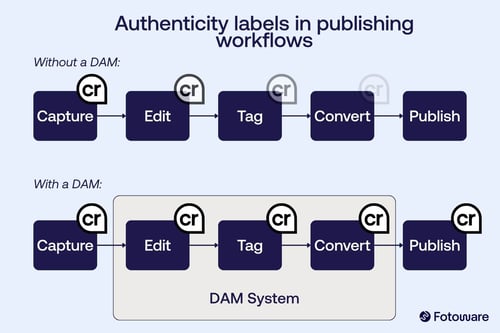
A disclosure only counts if it makes it to the person that is consuming the content. In most organizations, content passes through many hands between creation and publication. It is copied, resized, reformatted, and pushed to different channels, and at each of those hand-offs the origin information and metadata can fall off. The marker written at creation is rarely the one that reaches the published image.
That makes Article 50, in daily terms, a question about the systems content moves through rather than the moment it is made. A Digital Asset Management (DAM) system is where assets are stored, approved, rights-cleared, and routed, which makes it the natural place to hold origin information and carry it onward.
Read more: The EU AI Act and DAM: labeling AI and proving authenticity - by Alexander Karst
AI-labeling and Content Authenticity are the same record
This is where Article 50 meets the wider Content Authenticity conversation. The record that flags AI is the same record that can confirm origin: not only that something was generated, but that a genuine asset came from a known source, unaltered. The two are one mechanism viewed from opposite sides.
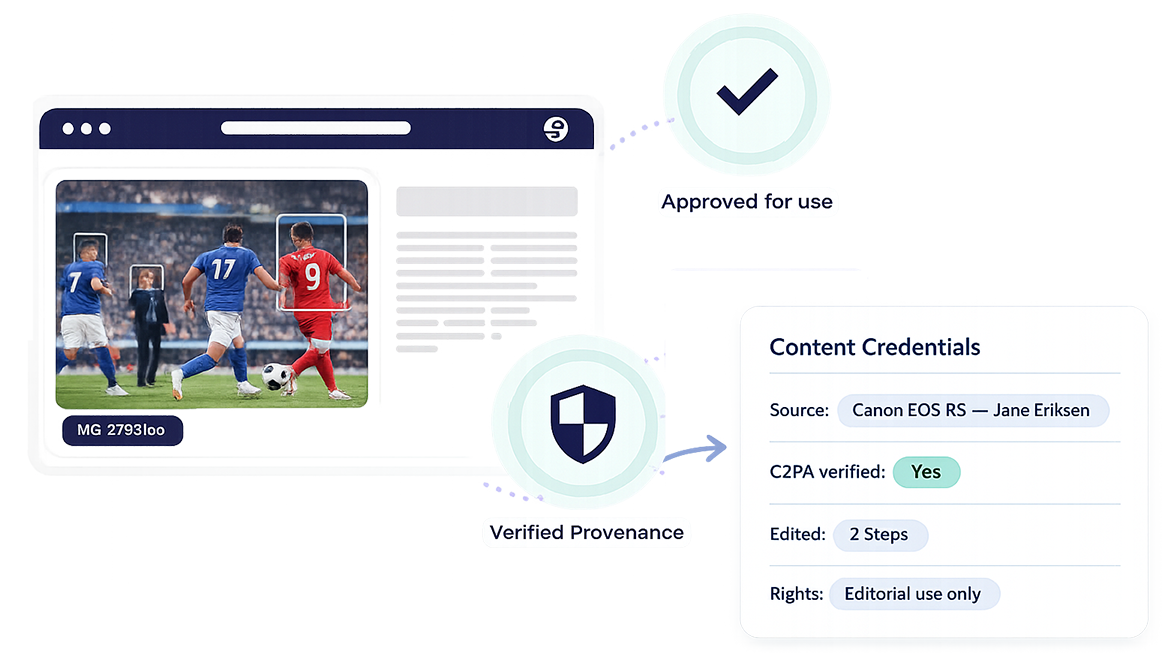
That mechanism is content provenance, and the open standard for it is C2PA, from the Coalition for Content Provenance and Authenticity. It lets cameras, editing software, and AI tools attach a tamper-evident record, shown to viewers as Content Credentials, describing how a piece of media was made and changed. C2PA is widely seen as the most practical open route to the machine-readable marking Article 50 points toward.
Read more: What is C2PA? A guide to Content Credentials and content provenance
The role Fotoware plays in ensuring Content Authenticity
Fotoware has been involved in this since the early days of the Content Authenticity Initiative, the coalition behind C2PA. The current focus is extending native Content Credentials support across the DAM platform, with one aim: to make provenance the default state of every asset moving through a Fotoware DAM, from capture to publication.
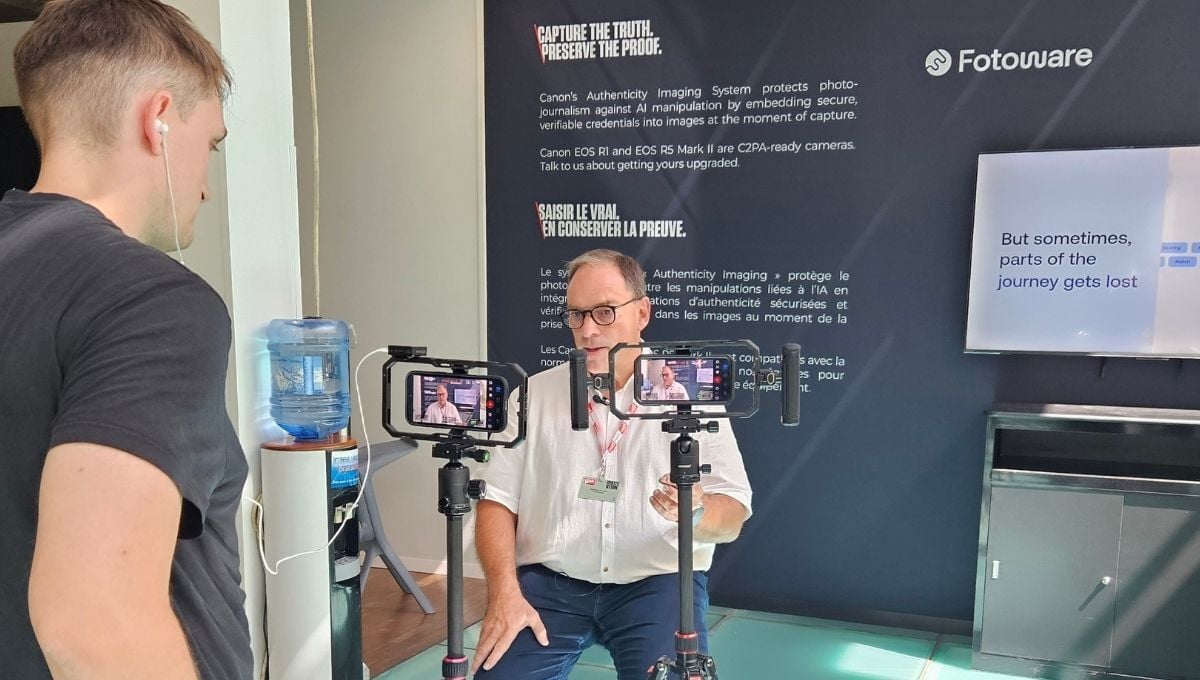
An early version is already running with Reuters, Canon, and Starling Lab, where a Fotoware Digital Asset Management system serves as the system of record between capture and distribution. A camera signs an image the moment it is taken, and the authenticated file is ingested into the DAM for review, captioning, and routing without breaking the signature.
Read more: Content verification: A project for photo authenticity in journalism
The point for any team evaluating Article 50 is that a DAM is well suited to the part of the rules that is hardest to satisfy by hand. Because provenance data and AI markers can be preserved automatically as assets are edited, converted, and distributed, disclosure stops depending on a person having to reattach it. Rules can be set once and applied to every asset, so a signed image stays signed and an AI marker stays readable all the way to the channel.
A capable DAM turns "keep the label attached from creation to publication" from a manual, error-prone task into something your systems handle by default. As transparency expectations tighten that is one of the most practical advantages a content operation can have.

On-demand Expert Conversation
Understanding the EU AI Act
Join DAM expert Frédéric Sanuy in our on-demand event to learn about the transparency obligations under Article 50 of the EU AI Act.
On this page