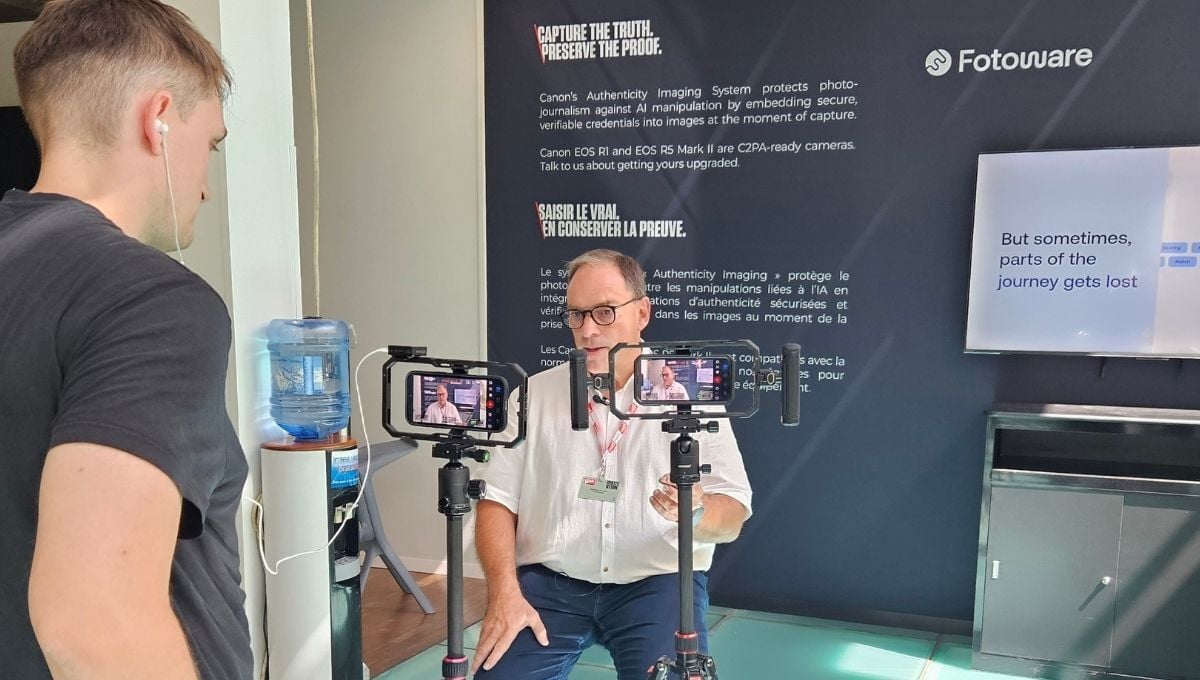
The Fotoware x Canon Content Authenticity booth at photojournalism festival Visa pour l'image 2026.
Proof builds trust: making Content Authenticity work in Media workflows

Webinar
Proving what's real: the role of DAM in content authenticity
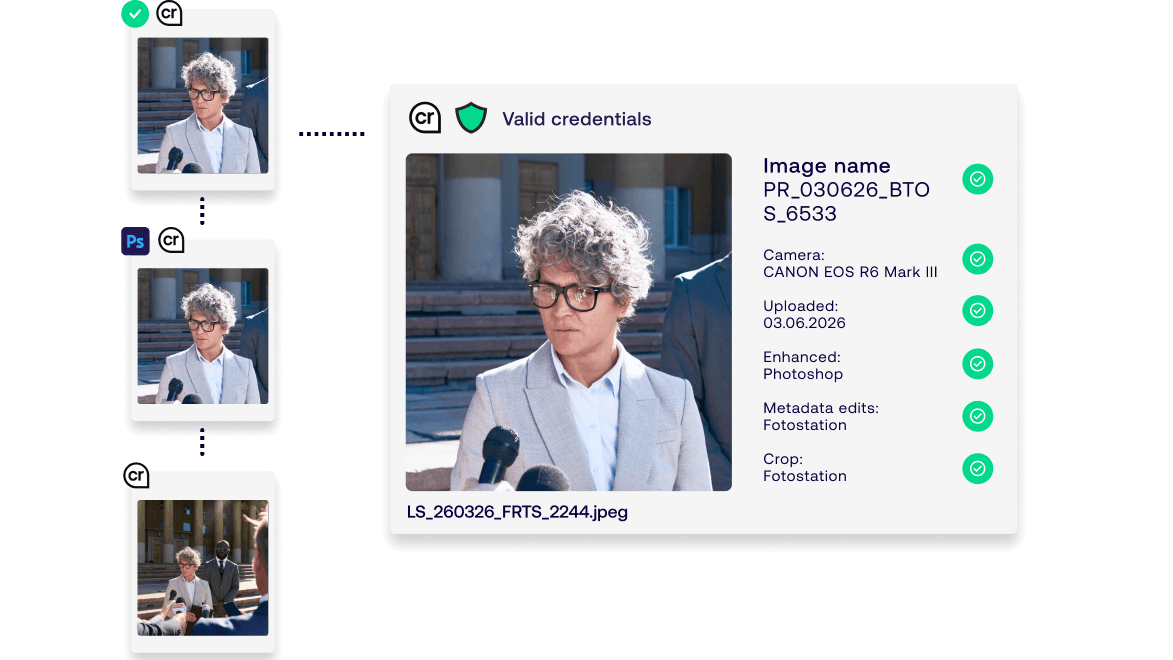
Discover why some content credentials break, and the role Digital Asset Management systems plays in ensuring that they don't.
Breaking news workflows need fast, verifiable content decisions
 The value of this glass to glass workflow for newsrooms becomes particularly clear when time is short during breaking news.
When an important image arrives, the newsroom does not have unlimited time to investigate it. Editors need to find the correct asset, understand its source, check whether it has been altered, confirm how it can be used and move it into publication. The slower or more fragmented that process is, the greater the risk of using the wrong content or missing the moment entirely.
The goal is not to make journalists audit every asset more slowly. It is to give them faster confidence.
When provenance information is preserved alongside searchable metadata, usage rights, version history and editorial context, the newsroom has a stronger basis for deciding what to use. Teams can spend less time searching across disconnected systems or chasing answers through email, and more time applying editorial judgement where it is actually needed.
This is also why authenticity cannot sit in a separate technical corner. It has to be part of the same environment used to find, manage and distribute content. Proof is most valuable when it appears at the moment a decision is made.
C2PA supports content verification but it does not replace journalism
It is important to be clear about what C2PA does not do.
It does not decide whether a photograph is truthful. It does not remove the need for journalism, verification or human judgement. And it will not, by itself, solve the broader decline in trust in media.
What it can do is make the history of a digital asset more transparent and harder to tamper with unnoticed. It can help a newsroom distinguish between content with a verifiable provenance trail and content where the origin or editing history is unclear.
That is not the whole answer, but it is considerably more useful than another request to simply believe us.
The strongest approach will combine several layers: content credentials, durable metadata, rights information, watermarking where appropriate, secure asset management and clear editorial processes. Each layer answers a different question. Together, they help create a more defensible chain of evidence.
Read more: Content verification - A project for photo authenticity in journalism
DAM is evolving from an archive to an active part of trust infrastructure
 For many organisations, a DAM has traditionally been treated as an archive: the place content goes after the interesting work is finished.
That view is increasingly outdated.
In a modern media workflow, the DAM can act as the intelligent asset layer connecting capture, verification, enrichment, editorial use and distribution. It can preserve the original, maintain the relationship between versions, manage who can access an asset, record how it may be used and make the right content easier to find.
When provenance is built into that flow, the DAM also becomes part of the organisation's trust infrastructure.
This does not mean locking publishers into one closed ecosystem. Quite the opposite. News organisations work with different cameras, agencies, editing tools, storage providers, CMS platforms and distribution channels. Authenticity will only scale if the evidence can move across that landscape using open standards.
Our ambition at Fotoware is to help connect those parts. We want provenance to remain useful as content moves, and to help newsrooms turn technical evidence into practical confidence.
Read more: Fotoware launches Content Authenticity - complete C2PA support in the DAM
Proof, provenance, and editorial judgement build lasting audience trust
The public may never know every system an image passed through before it reached them. They should not need to.
But publishers should be able to show where their content came from. Journalists should have better evidence when making decisions. Photographers should have a stronger connection to their work. And audiences should have a way to inspect the provenance behind what they are seeing when questions arise.
That is what makes the work around C2PA important. Not the acronym itself, and not the opportunity to add "authenticity" to another product page. The value is in creating a visible, verifiable chain between the person who captured an event, the newsroom that reported it and the audience receiving it.
Trust will still be earned through journalism. Through accuracy, transparency and consistent editorial judgement over time.
Technology cannot replace that work. But it can help us show it.
Proof builds trust. And trust is far too precious to leave to a slogan.

On this page