
Angélica Cordova in an internal tutorial video for their Fotoware DAM system.
Sebrae’s shift from file storage to scalable content infrastructure

Sebrae produces and uses content at scale, across regions, teams, and disciplines. As the organization continued to grow, the way digital assets were created, stored, and shared became an increasingly important part of day-to-day work. This article looks at how Sebrae approached digital asset management with a long-term perspective.
The challenge: Fragmented content and growing complexity
As organizations grow, managing content becomes increasingly complex. Files are stored across different systems, teams work in silos, and finding the right asset often takes more time than creating it. For large, distributed organizations like Sebrae, this challenge quickly reached a critical point.
Sebrae, the largest Brazilian organization supporting small businesses, produces vast amounts of content every year. Images of small entrepreneurs and their businesses or events, videos, and documents are created across multiple regions and teams, making consistency and accessibility difficult to maintain. Over time, decentralized storage and independent workflows led to duplication, limited visibility, and inefficient processes.
Recognizing that this was not just a tooling issue, Sebrae took a step back and rethought its approach to Digital Asset Management (DAM).
The solution: From fragmented storage to shared infrastructure
Instead of solving isolated problems, Sebrae shifted its perspective: DAM should not be just a place to store files, but a shared infrastructure that connects teams and supports collaboration.
Together with Fotoware and implementation partner Amplex Brasil, Sebrae began building a centralized DAM foundation in 2023. Rather than introducing a system all at once, they focused on a gradual rollout and are planning on onboarding business units step by step into a shared environment.
This approach allows the organization to scale sustainably while minimizing disruption for individual teams.
A key element of Sebrae’s setup is its hybrid architecture, combining Fotoware On-premises systems and Fotoware Veloz (cloud) services. This ensures both scalability and cost efficiency while supporting different use cases across the organization.
Get the Feature Overview for Fotoware Veloz >
At the same time, Sebrae adopted a federated model: a central framework defines structure and standards, while regional teams maintain control over their own content. This balance between governance and flexibility enables consistency without limiting autonomy.
To make content truly usable, clear metadata standards and lifecycle rules were introduced. Assets are now consistently tagged, easy to find, and managed throughout their lifecycle from creation to archiving, ensuring long-term control and relevance.
Read more: Metadata tagging - best practices
To support adoption, Sebrae invested in high-quality visual training materials, providing a practical overview that helps build both knowledge of and confidence in Fotoware.
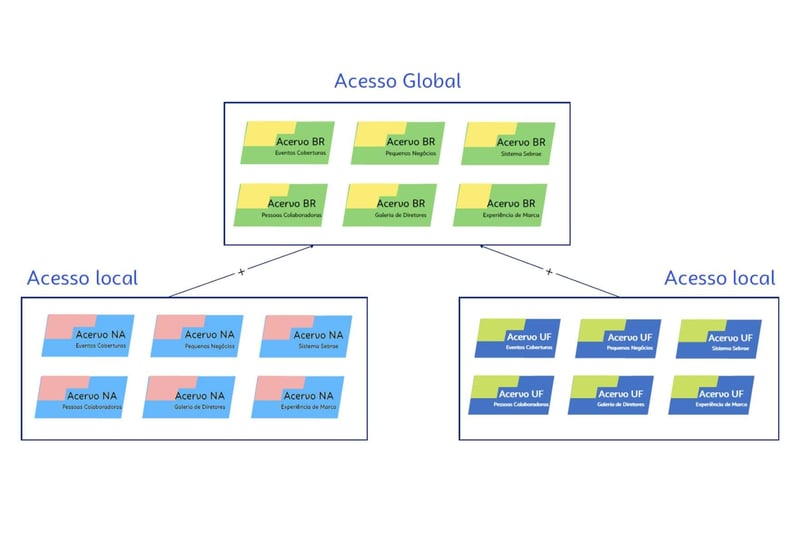 Archive structure: Local archive access (accesso locale), as well as cross-organizational archive access (accesso Global).
The result: improved collaboration and a foundation for future growth
The real impact of this transformation is visible in daily workflows. Instead of searching images across disconnected systems, users can now quickly find and share content across teams. Collaboration has improved, duplication is reduced, and processes such as content requests and approvals are handled more efficiently.
Even though the rollout is still ongoing, the benefits are already clear. Teams have more visibility, collaboration is improving and there is greater confidence in the content being used.

— “At Sebrae, we realized that managing digital assets was not just about organizing files, but about enabling collaboration across a distributed organization. By treating DAM as infrastructure, we are creating a shared foundation that connects our teams, strengthens governance, and allows us to scale content in a sustainable way.”


On this page