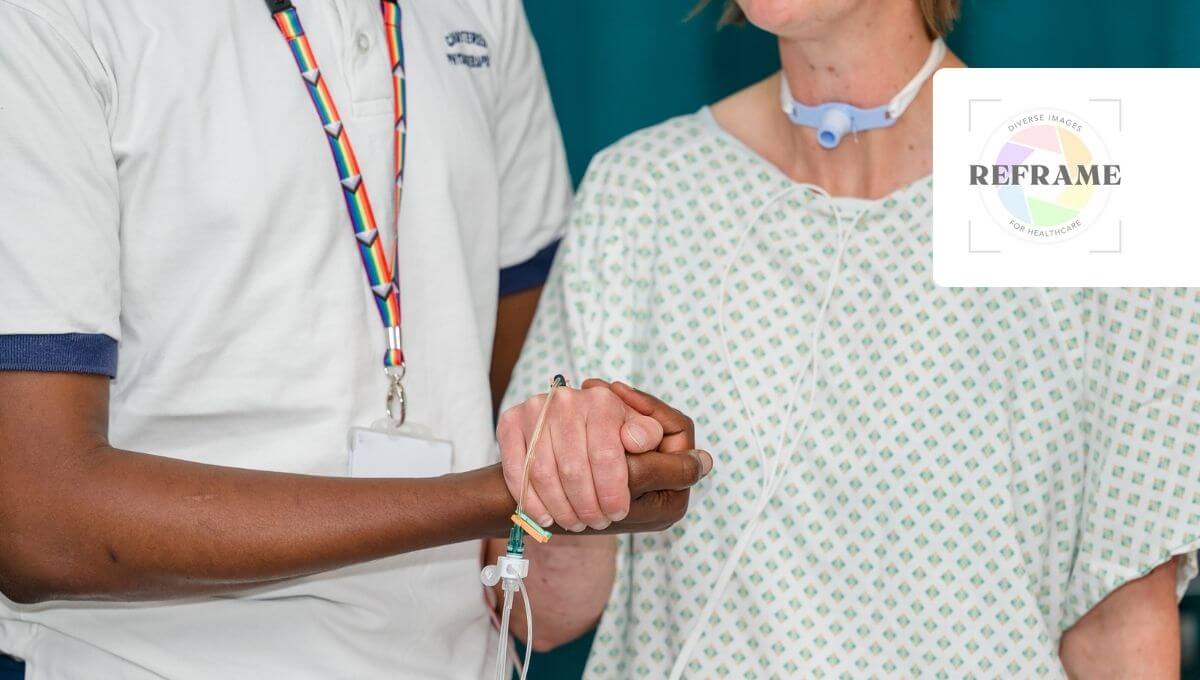
Image from the Reframe Image Library. © University Hospitals Bristol and Weston NHS Foundation Trust.
REFRAME: Supporting inclusive healthcare through photography

Healthcare is a highly visual discipline. From medical education to clinical decision-making and public health communication, images shape how clinical conditions are recognized, understood, and treated. But for decades, the visual foundations of healthcare have been incomplete, lacking representation in regards to race, disability and LGBTQIA+.
The Reframe Project was created to address this gap by building an open-access medical image library that shows how conditions appear across a wider range of skin tones, bodies, and backgrounds. Funded by NHS England and led in collaboration with academic and clinical partners, Reframe uses technology from Fotoware, implemented together with UK partner Medialogix, to make these images accessible, searchable, and usable at scale.
The challenge: when healthcare images don’t reflect reality
Medical conditions can present differently depending on skin tone and other physical characteristics. Yet many healthcare resources have historically relied on a narrow visual representation, with most reference images showing white skin.
This lack of representation creates real-world consequences. Without reliable visual references, healthcare professionals may struggle to recognize early signs of illness, educators lack inclusive teaching materials, and patients may not see themselves reflected in healthcare information.
Reframe was established to tackle this challenge head-on: not by adding a handful of images, but by creating a structured, trustworthy, and openly accessible image library that could be used globally.
Building a shared visual reference for healthcare
At the core of the Reframe Project is a growing collection of high-quality medical images, made freely available for healthcare professionals, educators, students, and the public.
The library covers two main areas:
Clinical conditions across diverse skin tones
The image collection includes a wide range of medical conditions and clinical signs, documented across different skin tones and body types. The goal is to provide realistic reference material that supports learning, diagnosis, and awareness. It’s not just useful in specialist contexts, but in everyday healthcare practice.
Inclusive representation of the healthcare workforce
Reframe also addresses representation in healthcare recruitment and communications. Alongside clinical imagery, the library includes images of healthcare professionals from underrepresented groups, captured in realistic clinical settings. These images are already being used by universities, NHS organizations, and organizations within the public sector.
Together, these two strands ensure that Reframe supports both clinical accuracy and broader inclusion in how healthcare is taught, practiced, and communicated.
— “Since its launch, the project has made significant progress capturing a diverse range of medical conditions and healthcare professionals. This couldn’t have been done without the support and commitment from key communities and organizations. This project is reshaping how diversity is represented in healthcare, making lasting change for patients, staff, and the system.”

From community contribution to global access
The Reframe Project’s image collection was built in close collaboration with local communities, healthcare professionals, and medical photographers. Rather than relying on stock imagery, the project worked directly with people willing to contribute their images to help improve healthcare outcomes for others. Today, the collection includes more than 3,000 approved and searchable images, showing a wide range of medical conditions across skin tones, including eczema, jaundice, and more.
However, capturing images was only part of the challenge. To achieve the intended impact, the project needed a platform that could:
-
Organize thousands of images consistently
-
Support precise search and filtering
-
Make images easy to access and download
-
Scale as the collection continues to grow
-
Remain open and simple to use, without barriers
This is where Digital Asset Management (DAM) became essential.
The role of Fotoware: enabling access, structure, and scale
To support the Reframe Project, Fotoware provides the DAM solution that the image library is built on, implemented together with their UK-based partner, Medialogix.
Rather than functioning as a traditional image archive, the DAM enables Reframe to operate as a living, evolving resource.
Key aspects of the setup include:
- Structured metadata and taxonomies
Images are categorized using consistent terminology, making it possible to filter by clinical condition, body area, profession, or healthcare setting. This ensures users can quickly find relevant images without specialist training. - Flexible access and reuse
Images can be downloaded in different sizes depending on use case, while maintaining clarity around usage terms. - Scalability through SaaS
Using a cloud-based DAM solution allows the platform to evolve continuously as new images and contributors are added, without disrupting access for users. - Global availability
The platform supports the project’s ambition to remain open and accessible worldwide, enabling educators, clinicians, and organizations far beyond the UK to benefit from the library.
By combining structure, accessibility, and governance, Fotoware helps ensure that the Reframe image library remains both usable today and sustainable for the future.
Get the Fotoware Veloz Feature Overview. >
— “Because this is a software as a service solution, it can be up and running within a matter of hours rather than weeks or months. That meant the team could start working with it almost immediately.”
Impact on diversity and inclusion in practice
The Reframe image library is already being used across healthcare and education. Universities have embedded the collection into their learning platforms, NHS organizations use the images in training and recruitment, and professional healthcare institutions reference the library in clinical guidance and educational resources.
Because the images are openly accessible, the barrier to use is low. This allows organizations to adopt more inclusive imagery without additional licensing costs or complex workflows. Within the first 2-3 months after launching, the system showed over 16,000 downloads.
Over time, this creates a compounding effect: the more the images are used, the more inclusive healthcare education and communication become.
— “The whole point of us doing this and making it open access was that anybody would be able to access it. We didn’t want it to be behind a paywall. We didn’t want people to have to log in. We just wanted people to be able to get the images, use the images, and benefit from them.”
DAM beyond marketing: supporting societal impact
Reframe demonstrates how DAM technology can play a role far beyond traditional marketing or communications workflows.
By providing structure, governance, and access to sensitive, but essential, visual content, DAM becomes an enabler of:
- Better education
- More accurate clinical reference
- Reduced health inequalities
- Increased trust and representation
— “The response has been overwhelmingly positive. Everybody who sees it thinks it’s amazing, particularly the fact that it’s free and openly available. We are consistently being asked to go and talk about it, to present it, and to share how we’ve done it.”
Read more: DAM for Good: When content carries responsibility
Looking ahead
The Reframe Project continues to expand, with plans to add more images, involve additional medical illustration teams, and grow the library over time.
With Fotoware and Medialogix supporting the technical foundation, the platform is designed to evolve alongside healthcare needs. Long-term, this will ensure that future generations of clinicians, educators, and patients have access to visual resources that better reflect the diversity of the communities they serve.
The Reframe Project: How DAM Drives Inclusion and Diversity
Discover how a public image bank can support more accurate diagnosis and promote inclusion in healthcare.
Related content
-
WERBINAR: The Reframe Project: How DAM Drives Inclusion and Diversity
-

DAM for Good: When content carries responsibility
-
Celebrating Excellence: Reimagining DAM Awards 2026
-
HEKS/EPER: Responsible content management for global aid projects
-
Inclusive leadership in practice: Six principles at Fotoware
-
Leading with purpose: CEO Anne Gretland on Equal Inspired Podcast
On this page