DAM vs MAM: Key Differences, use cases, and when you need both

DAM (Digital Asset Management) and MAM (Media Asset Management) are both systems for managing media files, but they were built to solve different problems. DAM vs MAM: A DAM manages individual content assets for distribution and reuse, while a MAM manages long-form video and audio production timelines. The two systems serve different stages of the content lifecycle and are typically used together in media organizations In the Media & Entertainment industry, it’s common to require both.
Key takeaways
- A DAM is built around the individual assets, while a MAM is built around the production timeline.
- DAMs excel at high-volume content operations, metadata-driven automation, publication speed, and content & metadata governance.
- MAMs excel at long-form video and audio production workflows.
- The two systems are diverging: MAMs are deepening their capabilities related internal collaboration on multi-media files, while DAMs are turning into the operational layer of the wider content ecosystem.
- Most media houses need both, with clean handoffs at the points where workflows meet.
DAM and MAM land in the same conversation often enough that they get treated as variations of the same thing. However, the fact is that they’re very different and complement each other more than they compete. Below you can read what each system actually does, how they differ in practice, where they are heading next, and how to think about choosing.
A note for added perspective. Fotoware has worked with media houses for more than 30 years. Configuring DAMs for leading publishers, broadcasters, and cultural institutions has made one thing very clear: managing productions is not the same as managing the content library as a whole. Both the roles involved, and daily tasks performed by these, differ greatly, and the systems serving them best should differ too.
What is Digital Asset Management (DAM)?
Digital Asset Management (DAM) is the system organizations rely on to manage individual content items at scale: photographs, illustrations, logos, designs, audio clips, videos, and all the associated metadata that makes them findable years later. Within such systems, each file carries its own metadata, including its permissions, version history, path to publication, and more.
At its core, a DAM is an operational layer for content. It’s where marketing pulls the approved brand assets, where editorial finds the right photograph for the morning edition, where the collection manager retrieves visuals for the new catalog, and where the picture desk keeps track of image rights and licenses. Fotoware operates within this space, focused on structured, metadata-driven control of high-volume content libraries.
How does DAM fit into modern media workflows?
Explore how DAM supports publishing and distribution. >
What is Media Asset Management (MAM)?
Media Asset Management (MAM) is the system broadcasters and post-production teams use to manage long-form video and audio production through its lifecycle. The production timeline is the unit of work. MAMs handle ingests from cameras and feeds, proxy generation (creating lower-resolution versions of original footage), edit decision lists, version control across cuts, and integration with non-linear editing systems.
MAMs are built for the long, complex, time-coded objects that make up a finished broadcast. Where a DAM thinks in assets, a MAM thinks in productions. That single difference shapes almost everything else about how the two systems are designed.
What are the main differences between DAM and MAM systems?
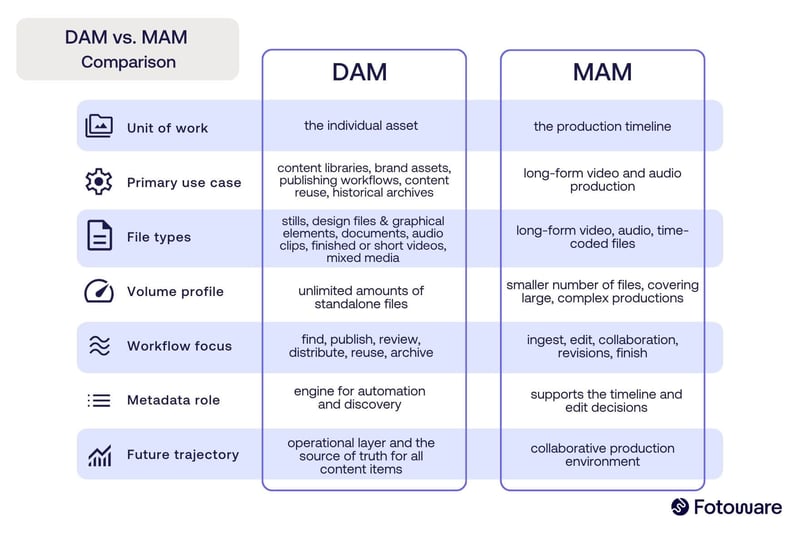
A DAM works at the level of the individual assets. A MAM works at the level of the production timeline. Almost everything else about the two systems follows from that.
| DAM at a glance |
MAM at a glance |
|
| Unit of work | the individual asset | the production timeline |
| Primary use case | content libraries, brand assets, publishing workflows, content reuse, historical archives | long-form video and audio production |
| File types | stills, design files & graphical elements, documents, audio clips, finished or short videos, mixed media | long-form video, audio, time-coded files |
| Volume profile | unlimited amounts of standalone files | smaller number of files, covering large, complex productions |
| Workflow focus | find, publish, review, distribute, reuse, archive | ingest, edit, collaboration, revisions, finish |
| Metadata role | engine for automation and discovery | supports the timeline and edit decisions |
| Future trajectory | operational layer and the source of truth for all content items | collaborative production environment |
There are primarily six areas where DAMs and MAMs differ:
1. Handling large volumes of individual assets
A DAM is built to make hundreds of thousands of standalone files navigable. Search, filter, faceted browsing, role-based access, and bulk metadata operations all assume that the unit of work is a single asset among many.
A MAM, by design, was not built for that kind of scale. For example, pushing an archive of stills into a MAM system creates messy structures the MAM is not built to maintain.
2. Publication speed
In Media & Entertainment, a photograph loses value with every hour that passes after the event.
A DAM that handles automated metadata enrichment, channel-specific renditions, and direct distribution can turn raw files into published content in minutes. For sports newsrooms and live events, that speed is the difference between leading a feed and missing it, and an area where a DAM is an essential part of the overall workflow.
3. Video handling and editing
For unfinished video content, MAMs can be essential in ensuring fast editing workflows, as they tend to support more heavy files, real-time editing of moving imagery, and often come with built-in collaboration capabilities for unfinished video projects.
While DAMs also support video, audio and animation files, they’re primarily built to handle finished assets. For this purpose, organizations handling large volumes of raw video- or audio content including MAM into the technical ecosystem is beneficial.
4. Metadata-driven automation
A DAM treats metadata as the engine, not the label. With consistent taxonomies and controlled vocabulary underneath, the system can route assets, enforce data governance, keep track of rights and licenses, trigger downstream workflows, and keep the collection clean as it grows. The better the metadata works, the less mundane tasks are left over for people to do.
A MAM system also uses metadata to structure assets and perform workflows but is typically more limited in its data-capabilities, oftentimes treating metadata merely as keywords. For small production companies with only a few productions, basic metadata functionality may do the trick, but larger organizations typically rely on added tools to handle metadata at scale in a manner that MAMs cannot.
Read more: The essential guide to image metadata
5. Content provenance and authenticity
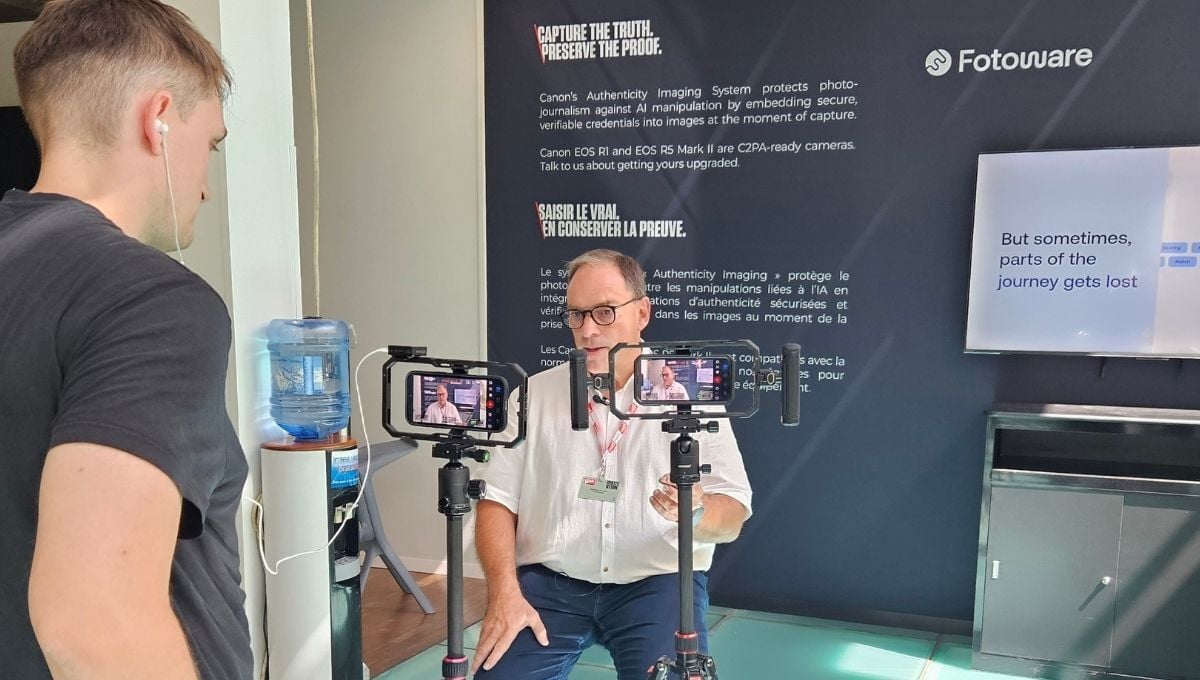
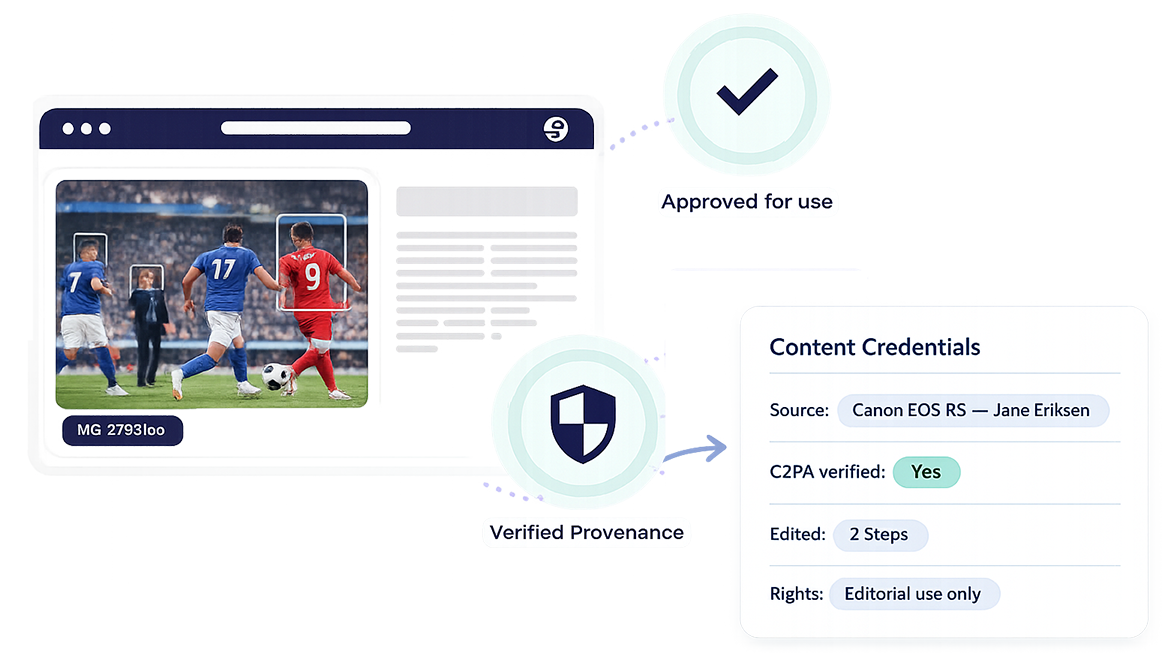
As AI-generated and AI-altered content blends into everyday feeds, organizations increasingly need to prove where a file came from, who touched it, and whether it has been changed since capture. Modern DAMs are positioned to track that lineage through the asset's life, and Fotoware takes this even further by investing in C2PA support and provenance tracking capabilities.
For publishers, broadcasters, cultural institutions, and other organizations concerned with content authenticity, an asset’s traceable provenance is becoming part of the product, not an administrative footnote. For such organizations, all systems touching the assets need ways of tracing their provenance, reinforcing the need for systems with advanced metadata capabilities, such as DAMs.
Read more: Content Authenticity - How to protect trust in the digital age
6. Ongoing project collaboration
The ways in which a team would collaborate on content are also likely to differ depending on whether they’re working in a DAM or a MAM. Both systems offer several capabilities related to collaboration, but these are often tied to different parts of the assets’ lifecycles.
In the case of DAM, collaboration would often involve making visual assets and information available to stakeholders, conduct semi-automatic approval processes, ensure governance and possibly using annotation- or note functionalities to perform simple reviews within the platform.
A MAM, on the other hand, is built to foster collaboration as a part of the asset creation process, optimized for granular revision rounds and real-time video editing.
In short, a MAMs collaboration capabilities are strongest during the asset creation phase, whereas a DAMs collaboration capabilities are strongest for finished content.
What breaks when a MAM is asked to do a DAM's job?
When configuring DAMs for leading media houses, we see a recurring pattern. A MAM has been stretched to manage everything, and the cracks show up in the same places:
- The stills archive becomes unsearchable. Metadata structures designed for productions don’t map well onto hundreds of thousands of standalone files. Search slows, duplicates multiply, and the team spends time looking instead of publishing.
- Brand control is low or non-existent. Marketing teams cannot find the approved logo, the up-to-date hero image, or the right campaign variant. Old assets get reused because the new ones are buried.
- Publication moves slowly. Without metadata-driven automation around renditions, rights, and distribution channels, every publish becomes manual. The cost shows up most clearly in live moments where speed matters, such as sports photography and news.
- Provenance gets lost. Long-form productions have clear lineage inside the MAM, whereas the thousands of standalone assets that surround those productions don’t. This results in a gap that’s harder to defend as content authenticity becomes a public question.
None of this is a failure of the MAM. Rather, it’s the predictable outcome of using one system to do another system's work.
Read more: Fully automating the Editorial Workflow: A Case Study of Mediengruppe Klambt
Who needs a DAM, who needs a MAM, and who needs both?
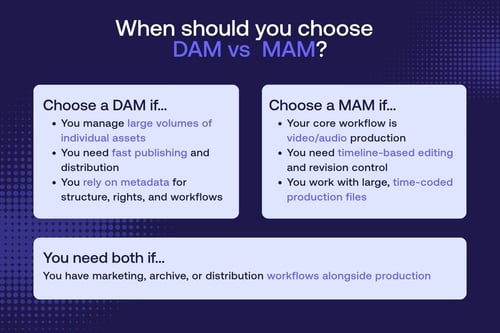
The honest answer for most organizations in Media & Entertainment is: both. A broadcaster running long-form productions needs a MAM to manage timelines, edits, and the back-and-forth processes of post-production. The same broadcaster, the moment it has a marketing team, a brand library, a press desk, a stills archive, or publishing channels to feed, needs a DAM to manage everything that is not the timeline.
The cleaner approach is to let each cover its own ground and connect them where the workflows meet. An example of such a workflow could be a short-form video leaving the MAM once it’s finished to live in the DAM, ready for distribution, rights management, and downstream reuse, with metadata flowing between the two so nothing has to be re-tagged. The result is one operational workflow across production and publication, with neither system pretending to be the other.
Read more: How Time Out transforms publishing workflows with Fotoware Veloz

On this page