Fotoware launches Content Authenticity: complete C2PA support in the DAM

Oslo, Norway, 10 September 2026. Today, Fotoware is proud to announce the launch of Content Authenticity, a new capability that gives organizations complete end-to-end support for the C2PA standard inside their Digital Asset Management (DAM) platform. It documents, and provides proof of, the provenance of every image and video, from the moment of capture through to publication.
What Content Authenticity does in the DAM
Content Authenticity is the process of ensuring valid documentation of the origin and lifecycle of a digital asset, such as a photo or a video. In Fotoware, the new Content Authenticity capability enables the system to preserve provenance data on ingestion and keep it intact throughout the asset’s entire lifecycle.
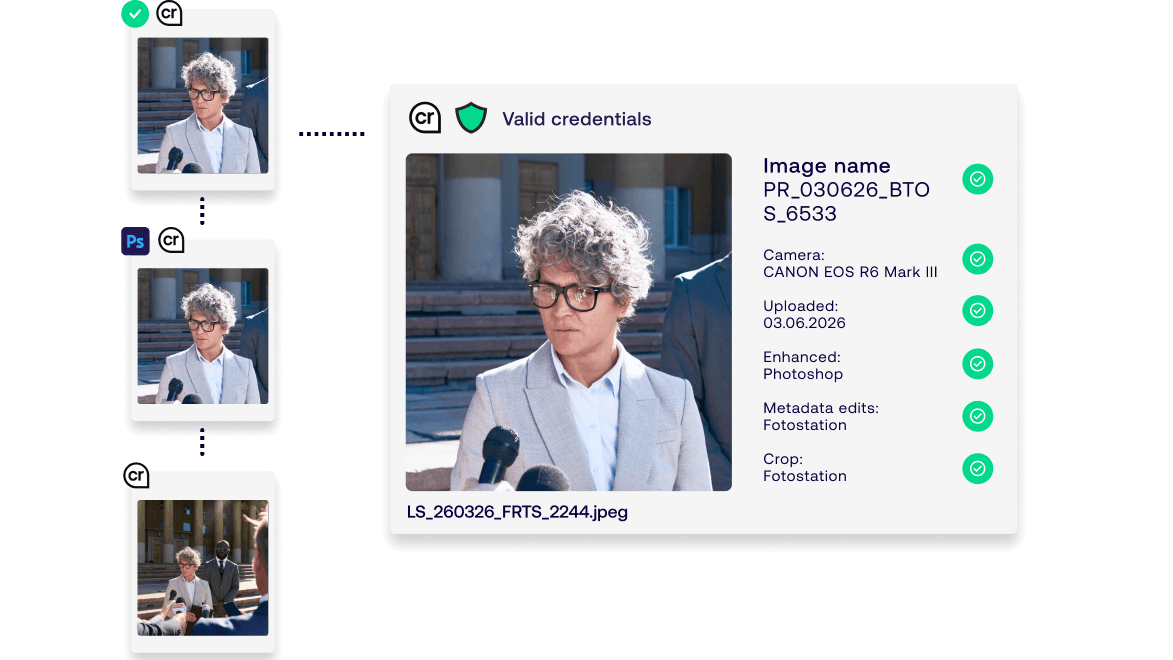
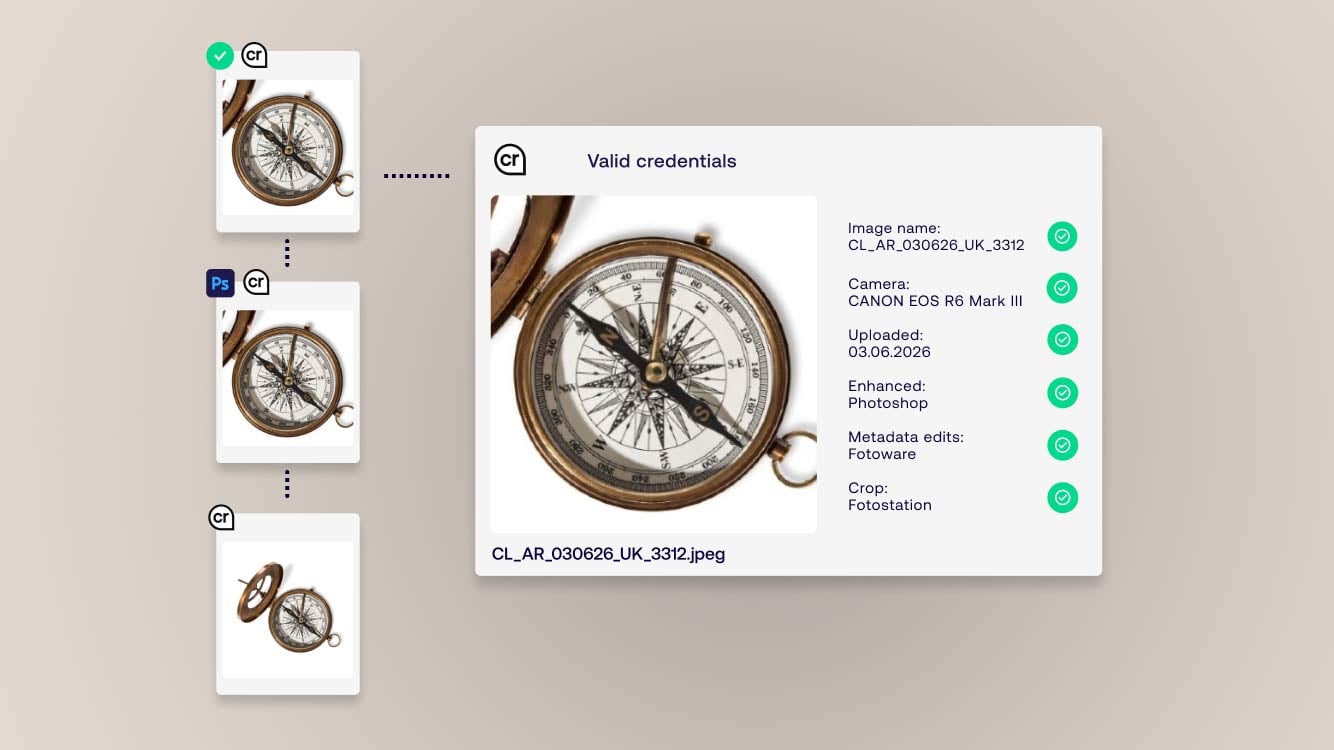
In addition to simply supporting the C2PA standard and preserving the data, Fotoware’s new capability also allows users to inspect content credentials in detail, viewing the complete and verifiable history of each asset. Built-in search- and filter capabilities also allow for easy exclusion of files that have invalid credentials, have been manipulated by AI, don’t originate from an actual camera, and more.

— The goal is for provenance to stop being a feature that one has to actively think about. It should be maintained by default, so that compliance happens because authenticity is handled by the system and not because someone remembered to check. Content Authenticity is the first release toward that, and it won't be the last.
READ MORE: What is C2PA? A Guide to Content Credentials and Content Provenance
Why now?
Documenting where an image came from has always been good practice, and for most of the history of photography it was also optional. A credit line and a trusted logo carried enough weight that few people asked for more. Generative AI has removed that margin. When anyone can produce a convincing image of an event that never happened, the credit line stops functioning as evidence, and the only thing that still holds is a verifiable record of the file itself: what device made it, what was changed, by whom, and whether an AI-model was involved at any point.

— In the years to come, we expect provenance tracking to increase in importance. At one point, every content owner is going to expect that the systems they use keep the provenance chain intact. We’ve built this now, so that organizations can take such actions immediately, instead of waiting until they’re the last ones to adapt
That record must be created and maintained as a matter of routine, not assembled after the fact when someone raises a doubt. Regulation is moving the same way, with the EU AI Act requiring organizations to mark content generated or modified with AI. For any organization whose credibility rests on the images it publishes, provenance documentation is becoming part of the basic hygiene of handling a file, and the systems those files pass through need to support such work.
READ MORE: The EU AI Act Article 50 explained
What end-to-end C2PA support means in practice
Also referred to as glass-to-glass C2PA support, the Content Authenticity capability in Fotoware ensures that the provenance chain is kept intact from the moment a photo is captured with a C2PA-compliant camera to its presentation on a digital channel. As the home of digital assets, the DAM carries a special responsibility of ensuring that every action performed within the system is documented in accordance with the standard, as to not damage the provenance data.
With the Content Authenticity capability in place, every edit, crop, metadata adjustment, or other action on the image, is preserved within the file’s traceable history, and made available to future users in other inspections tools. Additionally, every edit done in third-party systems will be signed and traced in the same way, offering a complete chain of provenance. This way, the proof travels with the assets, also when they leave the DAM.
READ MORE: Get proof behind every image
What makes Content Authenticity in Fotoware different
On the surface, C2PA support could mean something as simple as keeping the provenance data intact. If this was the limit of the functionality, one would need to rely on third-party verification tools to check provenance. In Fotoware, the Content Authenticity capability allows users to perform in-depth provenance inspections without leaving the system.
For example, if a photo is the result of a combination of three other photos, the built-in inspection tool will show the user every single one, with their individual provenance data. This way, the system doesn’t just tell you if AI has been involved, but how, and to what extent, it’s been used.
Having a verification tool built into the system is also an advantage for any organization that cares about workflow speed and internal control. It enables every user to check for provenance without extra steps, and without compromising on speed, further decreasing the risks of human error or forgetfulness.
This is amplified with the system’s markers and filtering options, that automatically adjust to the provenance data of each file. For example, if the inspection tool recognizes AI involvement, the file will be automatically marked as such, making it easy to filter out and easy to avoid.
Live webinar 25th September:
Proving what's real: the role of DAM in content authenticity
A DAM in line with the industry standards
Fotoware recognizes IPTC, XMP and C2PA as the true industry standards, and offers full support for all metadata covered by them. While the systems are made to be highly customizable, adhering to established data standards is essential for any DAM to provide real value over time.
With a long history of working with large media houses, Fotoware respects and values the standards created and implemented by the industry itself. Combined with SFTP delivery, support of such standards ensures that proof travels with the asset throughout its entire lifecycle.
Media contact
Radmila Stoltz, Chief Commercial Officer, Fotoware
Radmila.Stoltz@fotoware.com, +47 471 43 633

On this page