
Øystein Syversen and Nina Metzger (both Fotoware) at Visuals Conference powered by PICTA in Hamburg, 2026.
Rebuilding image trust - Highlights from PICTAday 2026


Panel highlight: C2PA & IPTC - A major milestone in the fight against photo fakes
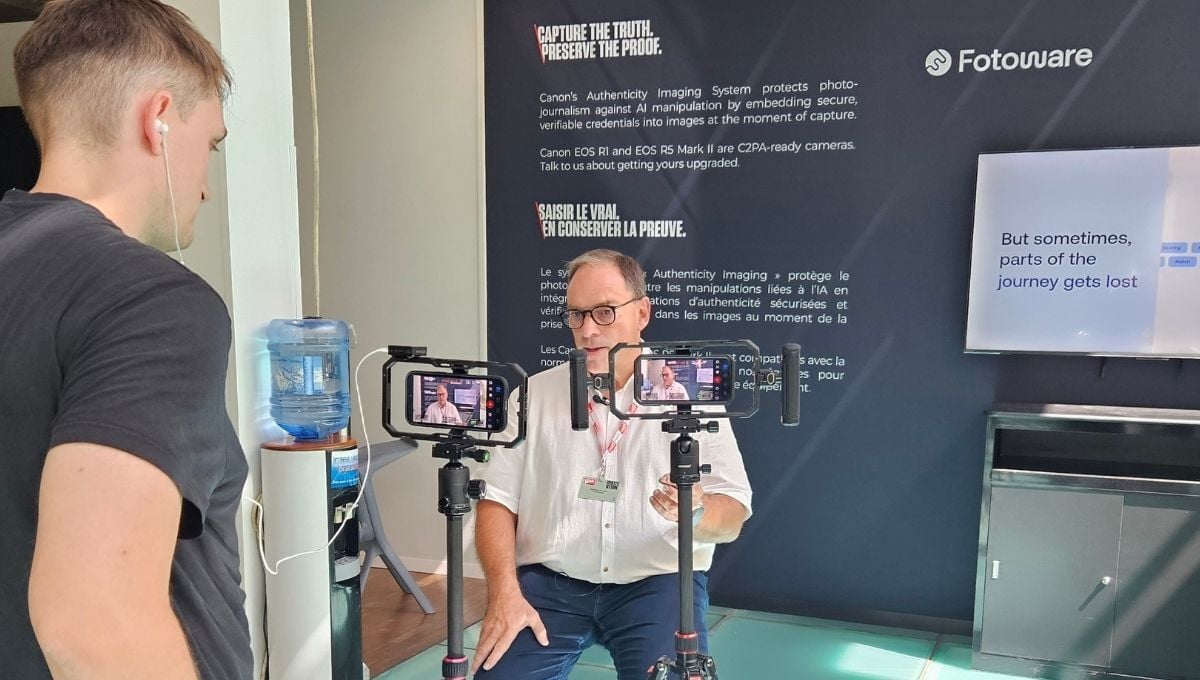
This was also discussed in a panel around Santiago Lyon (Head of Advocacy and Education, Content Authenticity Initiative), Robert Schmidt-Nia (Chair, IPTC and Head of Cloud Solutions, DATAGROUP), and Paul Melcher (Strategic Partnerships, Imatag).
They focused on standards such as C2PA and IPTC, which provide practical mechanisms for transparency through complementary, interoperable approaches. C2PA provides cryptographically secure, tamper-evident provenance by binding information about an asset’s origin and edits directly to the file. Fotoware already has a proof of concept implementation supporting C2PA and content credentials.
Read more: Content verification - A project for photo authenticity in journalism
IPTC metadata adds structured, machine-readable context, including indicators such as Digital Source Type that can label AI-generated or synthetic content. Together, these standards form a practical foundation for transparency across the visual supply chain, from capture through distribution and publication.
The core of this panel: Provenance is not about proving what is true. It is about providing reliable context at scale.

Building visual trust into everyday workflows
In today’s media environment, “truth” can be difficult to establish consistently. Context, however, can be documented and shared. This is what makes provenance and metadata valuable. They do not guarantee certainty, but they support more informed decisions.
The challenge is not a lack of standards or technology. The challenge is adoption at scale. To be effective, these standards must be integrated into the tools and workflows that practitioners use every day. Without implementation, they risk remaining largely theoretical.
Read more: Content Authenticity - How to protect trust in the digital age
This is why the conversations at PICTAday were timely. There is increasing alignment across media organizations, enterprises, and technology providers that visual trust must be treated as core infrastructure. It should not be an optional enhancement, but a foundational part of the content lifecycle.
For organizations working with images at scale, this has direct operational implications. Trust should be built into workflows from capture through distribution, so that authenticity information remains attached to the asset and can be assessed wherever the content is used.

Conclusion
At Fotoware, this perspective informs our work in Digital Asset Management. Our focus with C2PA and Content Credentials is to support Content Authenticity checks and to help ensure that context remains attached to content throughout its lifecycle.
The main takeaway from Visuals Conference powered by PICTA 2026 is clear: trust in images can no longer be assumed, it must be built. With the right standards, and sustained commitment to implementation, the industry can build trust that is verifiable and durable. Fotoware is ready to integrate these standards with our working POC supporting Content Credentials in Fotostation and Fotoware Veloz (SaaS).
Read more: Fotoware launches Content Authenticity: complete C2PA support in the DAM


On this page