
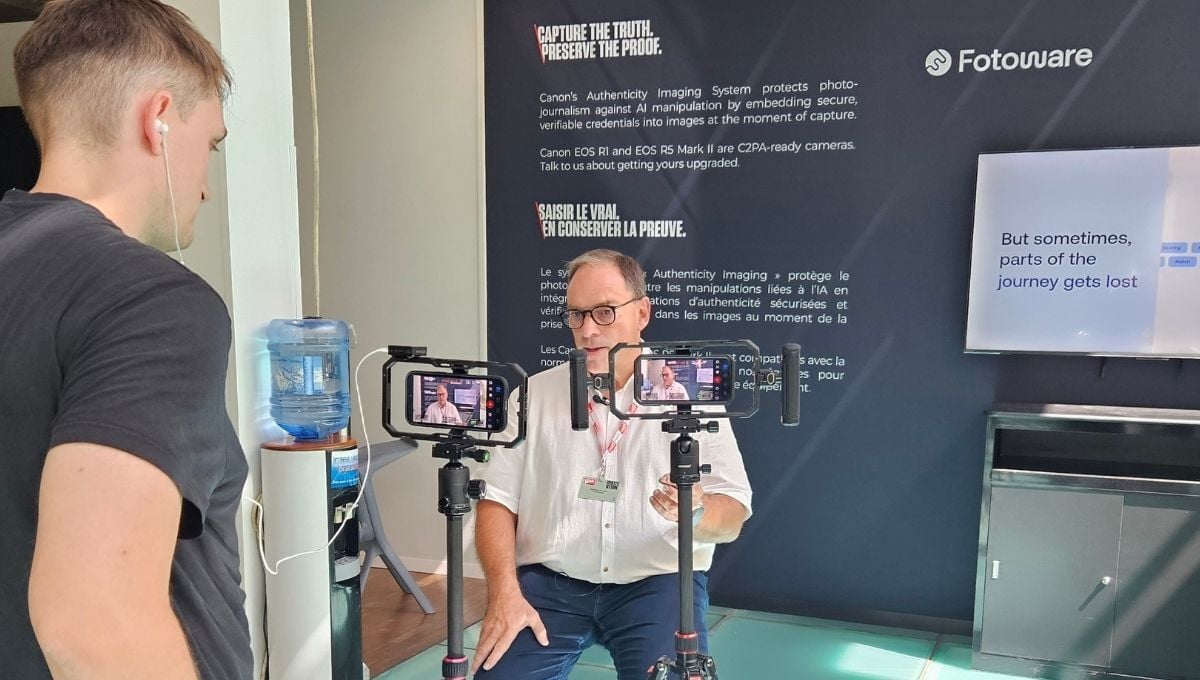
The Fotoware Team at WAN-IFRA, World News Media Congress 2026, Marseille, France.
Trust, speed and ownership: lessons from WAN‑IFRA 2026
This week we’ve been working from a rather unique setting overlooking the Marseille port, surrounded by some of the leading voices in news and media.
In this year’s edition of WAN-IFRA, the world News Association Congress, we’ve met partners, customers, and technology providers all focused on the same question: the future of news and journalism.
Through the congress, a few themes kept coming back across the keynotes and discussions, which I’ve tried to summarise in key takeaways.
Trustworthy and engaging stories delivered at speed
Modern publishing is no longer competing with other newspapers. It is competing with speed. Often the first image wins, even if it is not the best one. Visual speed increasingly determines attention.
Publishers often underestimate the complexity of the workflow: from camera to reader, and all the steps in between. This is where “glass-to-glass” workflows become critical: from capture to audience delivery, as fast and as clean as possible.
But speed won’t be enough if the content is not engaging for its readers. Whether it is video content, traditional or new stories formats, volume will not determine success.
Solana Pyne, leading The New York Times' newsroom video department, said in her presentation about the New York Times video strategy, that what determines success is Trust, Expertise and Impact.
All those can’t be leveraged by AI the same way that original journalism does.

During the conference we heard several success stories of media organisations reinventing themselves by building new concepts, fostering engagement while maintaining trust.
In his presentation, Gard Steiro, CEO of VG, shared how Norway’s leading digital media outlet is rethinking the news experience with a new concept: VGX.
Instead of a traditional front page, VGX offers a dynamic, content-driven feed where video is seamlessly integrated. The goal is simple: deliver fast, engaging news updates without forcing users to read multiple articles to understand a story.
Content ownership
AI, LLMs, and chatbots are reshaping how information is accessed. But beneath the innovation lies a difficult question at the core of journalism: Can AI be controlled and should it be allowed to absorb and reuse journalistic content without consent or compensation?
A standout moment of the conference was A. G. Sulzberger’s keynote, where The New York Times chairman delivered an unusually direct and uncompromising critique of big tech, seen by many in the audience as unprecedented. Data is not free, it is the product of human effort, expertise, and often risk.
AI companies are effectively:
- Taking original work
- Repackaging it
- And using it repeatedly, both in training and in live outputs
This raises a fundamental issue: AI is not just learning from the world, it is monetizing the work of others without paying for it. And the implications go beyond economics.
A weakened journalism ecosystem opens the door to:
- Misinformation and propaganda
- Conspiracy theories and deepfakes
- Increased polarization and distrust
Read more: The crisis of trust in digital content - GenAI and Content Authenticity
Building resilience and joining forces
Publishers and news organizations need to collaborate more closely, both in shaping regulation and in building solutions. This is no longer only about lobbying or policy influence but about execution. Collaboration is becoming essential to develop new tools, workflows, and capabilities.
Read more: Content verification: A project for photo authenticity in journalism
That was a very clear standpoint in The New York Times keynote who goes even further by saying that Journalism cannot fight this battle alone. Alignment with other creative industries, like music and publishing, will be critical.
During the conference we heard of initiatives such as joint AI Tools and chat bots for journalists showing how cooperation is already starting to take shape. As Fabrice Bakhouche, the CEO of Sipa-Ouest-France said, by joining forces, publishers can invest and learn faster while building the collective leverage needed to shape a win-win relationship with AI platforms.
Who owns trust?
The media landscape is undergoing rapid structural change. On one side, social platforms control distribution. On the other, AI chatbots and now even search engines increasingly deliver answers directly without sending users to original sources.
And in between: publishers.
News organizations are caught in a structural squeeze:
- AI captures the end-user experience
- Publishers create the value but lose proximity to it
The risk: the medium is starting to matter more than the content itself.
At a keynote by Brut’s Editor-in-Chief and producer, one message stood out: trust is the most valuable asset any organization can build today.
So the central question becomes: Who owns trust? Will people trust systems that aggregate information or the sources that produce it? In the era of fake news, news organizations will have a responsibility in verifying content, proving its provenance and authenticity.
Choosing content management solutions supporting a glass-to-glass authenticity workflow from camera to publication will become essential.
Read more: Content Authenticity: How to protect trust in the digital age

Leadership in transformation
Ultimately, how do newsrooms lead through disruption? According to FT strategies who presented a report called the Future Newsroom Study 2026, we see three gaps emerging:
1. The strategy gap
Many newsrooms still do not fully align editorial decisions with long-term strategic priorities. That needs to change.
As Jane Barrett, Head of Reuters AI strategy, mentioned, 59% of leaders say that they communicate clearly. Only 8% of employees agree. “We need to lead ourselves so that we can lead others to what is the biggest transformation era in modern news”.
In a keynote on how to manage complexity and motivation through disruption, Ouest-France CEO shared a key challenge in the group’s AI journey: An attempt to enforce a homemade LLM (to protect content) didn’t work, as ~80% of employees were already using external AI tools in their free time.
The takeaway: empower rather than restrict, with clear AI governance in place:
- Editorial content goes through the internal LLM
- Other uses remain flexible
2. The skills gap
Training is becoming essential, through hands-on workshops, experimentation, and new hybrid roles. Newsrooms must move from individual excellence to collective capability.
Key skills now include:
- technology-enabled journalism
- audience engagement
- modern production workflows
Technical and editorial skills are converging.
As an example, we heard how some news organization have reorganised their newsrooms from a vertical-based approach based on news areas (sports, politics, culture) to a skills/format/audience-based approach.
3. The audience gap
Too often, focus remains on the story itself rather than how it travels or who it reaches.
Jonathan Levy, Managing Director and Executive Editor of Sky News UK, highlighted a clear shift: audiences are now video-first and mobile-first. Video is central to their 2030 strategy, and they have made video their most valuable asset while TV remains the legacy format. And importantly, AI cannot manufacture that value. It must be built through journalism and storytelling.
Winning today means:
- understanding audience behaviour
- adapting formats for younger audiences
- using personalised feeds
- building communities, not just content
The online magazine Brut presented how they have built a distinctive model: a social-first video news outlet reaching 2 billion monthly views, producing content with lightweight tools (often just an iPhone) and distributing exclusively across platforms like Facebook, Snapchat, TikTok, and YouTube.
Instead of asking audiences to adapt, Brut adapted journalism rethinking formats, platforms and storytelling to meet people where they are.

Conclusion
WAN‑IFRA made one thing clear: the future of journalism will not be decided by technology alone. Speed matters, but trust matters more. Ownership, content provenance, and workflows are becoming core editorial concerns.
News organizations that invest in resilient collaboration, clear governance, and audience‑aware storytelling will be better positioned to keep control of both their content and their relationship with readers. In a media landscape shaped by platforms and AI, that control may be journalism’s most valuable asset.



On this page