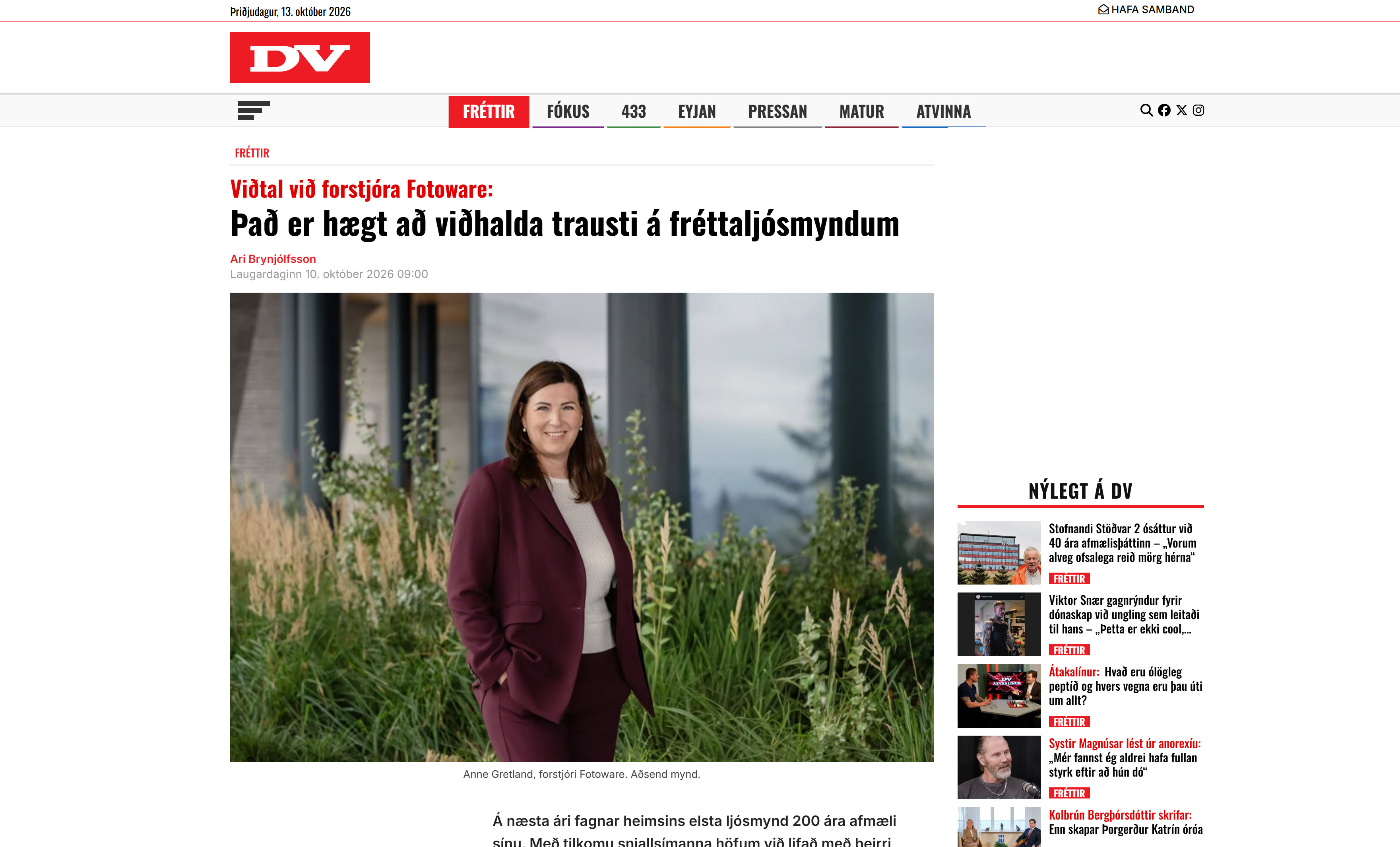
Anne Gretland, CEO of Fotoware, says verifiable images from trusted sources are now worth more than ever.
Trust in news photography can be preserved - interview with Fotoware CEO Anne Gretland

AI is making it nearly impossible to tell real photos from fake ones. In an interview with the Icelandic news outlet DV, Fotoware CEO Anne Gretland explains how C2PA Content Credentials can help media, police and archives rebuild trust in images.
The C2PA standard and the CAI
No single media outlet or image bank can solve this alone. Protecting the authenticity of images needs a shared effort across the whole chain of tools and systems an iimage travels through.
The Content Authenticity Initiative (CAI), founded by Adobe, has developed a shared standard, C2PA, that gives every photo a verifiable history.
The idea is that the camera tags a photo with C2PA Content Credentials. These show when the file was created and whether it has been changed. Photos often pass through many hands before reaching a publisher, so a DAM system is used to keep that information intact along the way. LinkedIn already supports the standard, and other social platforms are expected to follow.
Authentic images are worth more than ever
Fotoware, a Norwegian software company founded in 1994, started supporting C2PA in September 2026. Its customers include The Economist and Sky, and it once worked with DV on archiving and organising news photos.
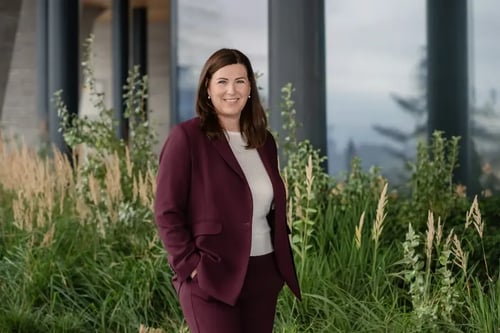 Fotoware CEO Anne Gretland's main points:
"AI will make the flood of information people face even bigger, and concern about authenticity, provenance and trust is growing.
Overall, the explosion of digital content will lower the value of media files, but only for some kinds of content.
Real photos from trusted sources, with a documented and traceable history, are now more valuable than ever.
The future of photography will be a clear split between verifiable content, which has real value, and unverifiable content, which will increasingly be seen as 'noise.'"
- The goal: nobody can just shout 'fake news'
Photojournalists won't become unnecessary. People need and want to follow world events, but they must be able to trust that what they see is real.
News outlets and image providers will need to show readers where an image came from and how it has been handled.
If publishers change their workflows so this information is published with the photos, photojournalism will matter as much as it does today, or more.
Fotoware joined the CAI in 2023 so its news and media customers can prove their images are real. The company also wants police to be able to prove that crime-scene photos are authentic, and wants cultural heritage records kept in their original form.
The goal is that nobody can dismiss reality, history, war images or crime-scene evidence as "fake news" or say "this never happened."
"Trust is very fragile"
AI photo editing is now so advanced that organisations that depend on public trust will have to adopt C2PA.
This matters most when they rely on photos sent in by the public, which is common for both police and media.
When asked, responsible organisations must be able to show where content came from and what has happened to it.
In Gretland's words: "The truth has become something that needs protecting."
Limits of the technology
Verification is getting harder, partly because metadata can be faked. Gretland stresses that C2PA can't prove with certainty that a photo is real. What it shows is where the image came from and how it has been edited, for example whether it has been cropped.
Her examples:
-
A photo sent to a newsroom whose metadata shows the background was blurred.
-
A photo of a protest on Austurvöllur, where the file could show whether the size of the crowd had been exaggerated.
Can trust in photography be restored?
Yes, but it takes real commitment from both the IT industry and the media.
Building C2PA support into the whole digital content workflow is a good start.
Organisations must also actively use the technology to avoid mistakes that damage trust.
Trust takes a long time to build and can disappear in seconds. Publishing a fake image can do lasting harm to a publication's reputation.
In a race to publish first, the few seconds it takes to verify a photo can feel wasted, but that time is well spent.
Closing point: photojournalists sometimes risk their lives to document the truth. Companies that build software and technology are responsible for helping to protect, preserve and verify that truth.
-
Article originally written by Ari Brynjólfsson and published in Icelandic by DV on 10. October 2026.

On this page