
5 common challenges easily solved with Digital Asset Management

The main benefit of Digital Asset Management is control: a DAM system stores every image, video, and graphic in one searchable hub and automates how those assets are found, shared, and retired. That control solves five common content challenges, namely files that get lost, slow collaboration, time-consuming publishing, manual rights revocation, and systems that cannot scale. Below, we explain each challenge and how a DAM solves it.
What content challenges does Digital Asset Management solve?
If you work with content production and distribution, you have probably come across the term Digital Asset Management (DAM). A DAM is an integrable system for managing digital assets such as images, graphics, and videos, and it does far more than a traditional media bank or ordinary cloud storage. Here are the five most common content challenges a DAM solves at a glance.
-
Files get lost or are hard to find
-
Content collaboration is inefficient and unreliable
-
Publishing content online is time-consuming
-
Revoking visuals is a slow, manual process
-
Your system does not scale
How do you stop files from getting lost or hard to find?
A DAM stops files from getting lost by keeping every asset in one central repository that people search by metadata, instead of by remembering a folder path.
With a traditional folder structure, you often need to know exactly where an asset is stored to find it. For example, you might be looking for the latest PowerPoint template but cannot remember whether it lives in the folder for PPTs, Sales Material, or Company Templates. Assets also get stored locally or in shared folders that only a few people can open, for instance a Google Drive folder shared with an external design agency. And when a colleague leaves, the video clips they saved locally can disappear with them.
Solution: build a system based on metadata
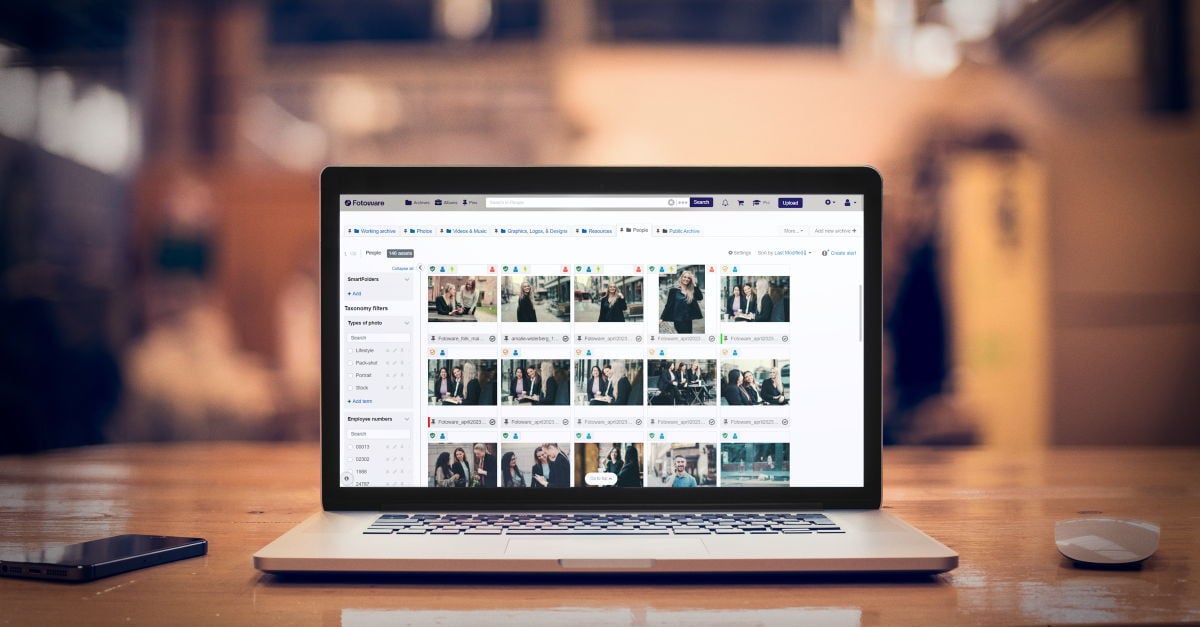
To stay in control of every file, store and manage assets from one central repository, whether it sits in the cloud or on local servers. A DAM works as exactly this kind of hub. Because it is built on metadata, you can offer people several ways to search for content instead of relying on fixed folders. Metadata is data about your data, and it lets users find assets by freely searching keywords or applying custom taxonomies to filter out formats and categories they do not need.

Webinar:
Metadata that fosters collaboration & control
Learn about how controlled vocabularies and shared methodology create consistency and collaboration across complex archives from keywording expert Clemency Wright.
How can teams collaborate on content more reliably?
Teams collaborate more reliably when every visual lives in one shared brand hub with role-based access and clear status markers, so no one works from outdated or unapproved files.
Content production usually involves a lot of collaboration. You may need approval from specific people before an image or design goes out, and visuals made with external partners often end up sent back and forth through email and zipped folders. Many assets, such as logos and sales materials, are also needed by people outside the communications team, which is one of the everyday challenges marketing teams run into. These assets should be easy to find but simple to revoke once they are no longer current.
Read more: 6 challenges marketing teams face when managing digital assets
Solution: store all visuals in an interactive hub
A DAM acts as a brand hub, so everyone finds the assets they need, when they need them. Advanced user settings let you tailor who sees what and communicate each asset's status with visual markers, which removes the worry of someone using outdated or unapproved content. Most DAMs also let you add notes to assets and share them externally through album functionality, without depending on third parties such as Dropbox or WeTransfer. This is one of the clearest differences between a DAM and ordinary cloud storage.
Bonus tip: build a public archive for external users
Many organizations go beyond internal access and use advanced user configuration to create semi-public or fully public archives. These can be set up in detail, for example letting visitors download watermarked versions of selected images. We see this more and more with open press archives and digital image collections, such as the one run by the White House Historical Association.
How do you make publishing content online faster?
You make online publishing faster by integrating your DAM with your CMS, so approved assets are searchable inside your website and drop in without a download-and-re-upload step.
Keeping your websites up to date takes time, especially when your online presence includes articles or newsletters that need fresh images and graphics regularly. Locating, checking, downloading, and re-uploading an asset is not hard as a one-off, but it adds up fast when you publish often.
Solution: integrate the DAM with the CMS
Integrating your DAM with your Content Management System (CMS) creates a direct link between your websites and your asset repository. Whenever you build a blog article or landing page, or swap a graphic, your selected assets are searchable and available through a web widget, and they import straight into the site. That saves time and keeps you in full control of your brand's online presence.
| System | Main role | Structured by |
| Digital Asset Management (DAM) | Store, manage, and distribute visual assets from one hub | Metadata |
| Content Management System (CMS) | Create and publish content on web pages | Site and page structure |
Bonus tip: use the API to build a content ecosystem
Most DAMs have an open API and connect to a wide range of systems, from design software to product information management and project management tools. Using it, you can build a content ecosystem with the DAM at the center, so every asset is available in the software your teams already use.
How can you automate revoking assets, rights, and licenses?
You automate asset revocation with metadata-driven workflows that trigger actions on their own, such as pulling an asset the moment its license expires or its consent is withdrawn.
Sometimes you need to revoke assets, whether the content is out of date, a license has expired, or for another reason. Without a DAM, this becomes a manual project full of internal messages to make sure the asset is pulled from every active folder, collection, and campaign.
Solution: build workflows to manage rights, licenses, and approval status
With a DAM, you can set up automated, metadata-driven workflows where specific actions fire once an asset's data changes. For example, a workflow can revoke an asset when its expiration date is reached, or publish it to your public archive once it is approved.
Read more: Sulzer’s DAM success: Goodbye to outdated marketing assets
Bonus tip: attach consent forms to your visuals
If your photos feature private individuals, consent management lets you attach custom consent forms to each asset. You can track exactly what use a person agreed to, and if they withdraw consent, the attached form updates automatically.
How do you make sure your DAM scales with your content?
A DAM scales with your content when it pairs advanced metadata and configurable workflows with an open API, so it keeps moving the right assets to the right places as volume grows.
Scaling content operations is one of the biggest challenges for today's organizations. More content is consumed online across more platforms and devices, and expectations for quality, relevance, and speed are high. Content volumes keep climbing, and older systems often cannot keep up.
Solution: choose a DAM with content operations capabilities
A modern DAM should do more than act as a media bank. It should help you scale content operations by moving the right assets and data to the right places at speed. A system with advanced metadata, flexible workflow configuration, and an open API has a strong chance of scaling as your organization grows and the market shifts, which is worth weighing when you compare the best Digital Asset Management software for your needs.

Looking for a DAM?
DAM buyer's guide
Get all the information you need for purchasing a Digital Asset Management solution with this free guide.
Digital Asset Management vs traditional storage at a glance
| Content challenge | Traditional folders or cloud storage | Digital Asset Management |
| Finding files | Depends on knowing the exact folder path | Metadata search and custom taxonomies |
| Collaboration | Files emailed back and forth, unclear status | Shared hub with role-based access and status markers |
| Publishing | Manual download and re-upload every time | CMS integration inserts approved assets directly |
| Revoking assets | Manual clean-up across folders and campaigns | Automated workflows triggered by metadata |
| Scaling | Breaks down as volume and channels grow | Open API and workflow automation scale with you |
On this page