Is your use of employee photos GDPR compliant?
Employee photos usually count as personal data under the GDPR, so they must be handled to the same standard as any other personal data you hold. Your organization is compliant when it informs employees of their rights, gathers specific and freely given consent for each use, and can locate and delete every image of a person on request. If you cannot do all three, your use of employee photos is likely not GDPR compliant.
If you work in marketing, communications, or HR, producing and sharing employee photographs is probably part of your job. However, many don't realize that photos can constitute personal data under the GDPR. This article shows you how to identify if your organization is GDPR compliant when using images of employees.
Why is GDPR compliance for images important?
GDPR matters for photos at work because images of employees are personal data protected by law, and failing to protect them risks heavy fines and reputational damage.
Enforcement has grown steadily since the GDPR came into force on 25 May 2018. By the cut-off date of 1 March 2026, European authorities had issued 2,685 fines, totaling around 6.11 billion EUR, an increase of 440 fines and 487.6 million EUR on the previous year, according to the CMS GDPR Enforcement Tracker Report 2025/2026.
The average fine across that period was about 2.28 million EUR, and the largest single penalty remains the 1.2 billion EUR fine issued in Ireland against Meta.
However, financial penalties are only part of the cost. Fines are public and often name the company involved, so a data protection failure can erode the trust of employees, customers, and partners long after the fine is paid.
Prioritizing consent management and GDPR compliance protects both your budget and your reputation, which makes it essential to keep your use of employee data, such as photos, GDPR compliant.
READ MORE: Best Practices for GDPR compliance when using images of employees
Is your use of employee images GDPR compliant?
You can check compliance with three questions. If the answer to any of them is no, your use of employee photos probably does not meet the GDPR standard.
| Compliance check | What the GDPR requires | Key articles |
| Do you inform employees of their rights? | Tell staff their rights and how to use them, including withdrawing consent, seeing their data, and erasure | Articles 7, 15, 17 |
| Do you gather proper photo consent? | Consent must be freely given, specific, informed and unambiguous, and kept separate from the employment contract | Article 7 |
| Can you find every image of a person? | Locate and delete all images of an individual within one month of a request | Articles 7(3), 17 |
1. Do you appropriately inform employees of their rights?
Your organization must inform employees about their GDPR rights and make sure they know how to use them. This includes the right to withdraw consent at any time (Article 7 - Conditions of Consent), the right to see their data (Article 15 - Right of Access), and the right to be forgotten (Article 17 - Right to Erasure).
READ MORE: How to comply with GDPR - Article 7 for photos and videos
2. Do you adequately gather photo consent from employees?
Consent must be obtained from employees and it should be “freely given, specific, informed and unambiguous” without fear of repercussions for choosing not to give consent. This means consent cannot simply be included as part of an employee’s employment contract. It must be clear what consent is being given for, including how the photos will be used. A standard form with a generic statement is therefore not in compliance with GDPR.
3. Can you find every image of an individual in your organization?
This is arguably the most difficult aspect of the GDPR for organizations to comply with, regarding the use of employee photos. What this means is that the employee can request for the organization to erase all their personal data, and the organization has one month to respond.
A typical example might be when the employee leaves the organization and doesn't want their image to be used anymore. For the vast majority of organizations, searching and finding these images will end up being a manual task, taking hours to trawl through hundreds if not thousands of folders of photos. However, the same goes for if a current employee withdraws their consent, as per Article 7(3).

Does your company need help with GDPR compliance?
Many companies do, because the GDPR can be confusing, especially when there is no legal precedent to guide a specific situation.
What is certain is that organizations must treat personal data about employees, including photographs, as seriously as they treat customer data. With fines for breaches rising quickly, it is essential to be properly prepared for every process, including managing images of staff.
How does Fotoware help you stay GDPR compliant?
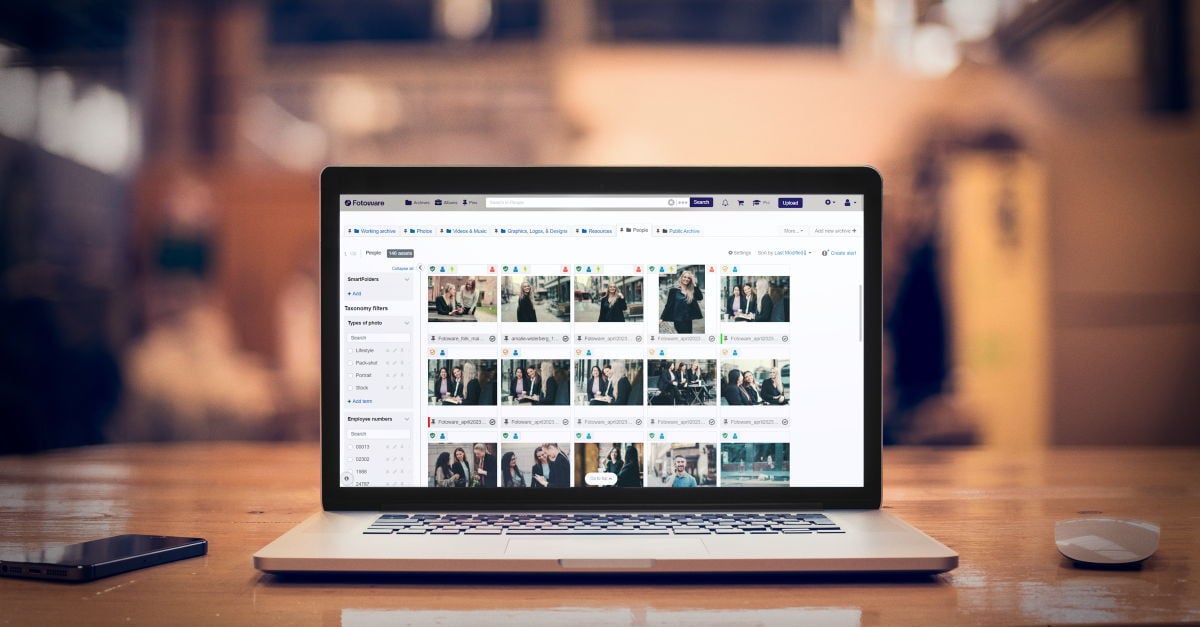
A Digital Asset Management system takes the manual effort out of the hardest requirement, finding every image of a person on request. Fotoware keeps images and their consent records together, so you can capture and track consent and then search and find any photo of an individual when they ask to access or delete it. You can see how Fotoware supports GDPR and consent management if you want to go deeper.
Frequently asked questions
-
Yes.
Photos of identifiable employees taken at work are personal data under the GDPR, so they must be handled to the same standard as any other personal data you hold.
Source: GDPR Article 4(1), definition of personal data, and Recital 51 on photographs.
-
In most cases, yes.
Consent must be freely given, specific, informed and unambiguous, and it must be clear what use the employee is agreeing to.
Source: GDPR Article 4(11), definition of consent, and Article 7, conditions for consent. Consent is one of the lawful bases in Article 6.
-
One month.
When an employee withdraws consent or asks to be forgotten, your organization has one month to find and erase every image of them.
Source: GDPR Article 12(3) on the one-month response time, with Article 17, right to erasure, and Article 7(3), withdrawal of consent.
Talk to us about Consent Management
Get in touch with our experts to find out how Fotoware can help your organization with GDPR compliance.
Fotoware empowers organizations to be GDPR-compliant through proper use of its Digital Asset Management systems, and cannot advise on any legal aspect of the GDPR. Fotoware makes no representation, warranty or guarantee of GDPR-compliance when using the product.
On this page