The future of DAM: 6 shifts every organization should prepare for


Shift #2: Governance moves out of the policy document and into the workflow
Most content governance still lives in policy PDFs that nobody reads when something needs to urgently happen. That gap is where rights leaks, embargo breaks, and brand mistakes happen. Compliance complexity is rising and AI regulation is following close behind, so governance that lives only in policy cannot keep pace.
Janniche Moe, CPTO of Fotoware, identifies content trust and governance as some of the main forces reshaping DAM, alongside evolving workflows and connectivity between systems. Compliance complexity is rising and AI regulation is following close behind. Governance that lives only in policy cannot keep pace.
Stephane Dayras, professional services manager at Fotoware, describes the DAM's responsibility concisely: it records and maintains conformance, compliance, rights, and permissions across the entire lifecycle of an asset, and the harder job is making those mechanisms simple enough that users actually follow them.
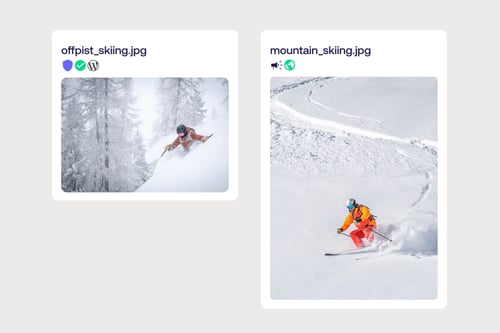
The shift is from telling people what to do to designing systems where the trusted path is the easiest one. Required rights fields, clear markers that show e.g. approval, and visible expiry dates do more than policy ever has, because they meet people at the moment of the decision.
Shift #3: Human review is reserved for decisions that need a human
Generative AI has multiplied the volume of variants moving through review. The number of reviewers has not changed. "Today, teams using generative AI can now produce up to 10 times the volume than ever before," Huddart notes, "but we still have the same number of people reviewing the content."
Reviewing every variant the same way breaks the team or the brand. The practical answer is a tiered model that routes assets by risk, reach, and reversibility. High-consequence work, regulated claims, embargoed launches, partner distribution, anything in print or out of home, gets deep human review. Repeatable derivatives from pre-approved templates move through a fast lane with automated checks. Exceptions escalate.
The DAM is where that routing lives, because it is the only system that sees the asset, the metadata, the rights, and the approval state at once. Done well, automation handles the repeatable checks and human attention stays on the decisions that actually carry consequence.
Shift #4: Content provenance moves from aspiration to infrastructure
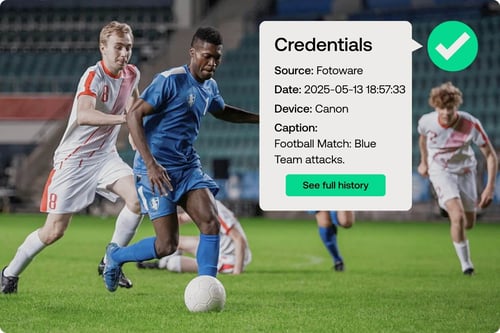
C2PA Content Credentials have moved from a working group concept to something real. Some cameras are already signing images at capture. For example, Google Pixel 10 smartphones now sign every photo at the device level. LinkedIn has also started showing the content credential icon in its feed. France Télévisions signs their daily broadcasts. And the International Press Telecommunications Council (IPTC) maintains a verified news publisher list, so signatures can be traced back to known sources.
Brendan Quinn, Managing Director of the IPTC, describes the journey ahead in brief terms at Reimagining DAM 2026: "We haven't even boarded the plane yet. We're still in the departure lounge." His comparison is to HTTPS. What started as an option became a default and then became invisible. The same arc is now evolving for Content Credentials and Content Authenticity.
For a DAM, the practical implication is that signing has to happen somewhere in the chain. The simplest pattern is to stamp at publish, where the asset is signed at the moment it leaves the pipeline. A more mature pattern reads incoming signatures, preserves them through editing, and re-signs on the way out. The longer-term destination is a full glass-to-glass workflow where every tool in the chain from camera to the audience preserves the signature.
This is not theoretical. Kevin Coombs, Picture Production Editor at Reuters, points out that handout images from brands sit in his queue every day with unclear rights and unclear edits. A signed file shortens the verification time. Richard Shepherd, Senior Product Marketing Manager at Canon Europe, frames the camera-vendor view simply: it is the right thing to do, and customers asked for it.
Read more: Content verification - A project for photo authenticity in journalism
Signed metadata alone is not enough. Files get compressed, cropped, and stripped in distribution. Watermarking and fingerprinting fill those gaps, which is why durable provenance now relies on three pillars working together: signed credentials, invisible watermarks, and fingerprints stored alongside the asset. Fotoware is building C2PA support across products, so the chain holds reliably.
These pillars, working together, are what make content credentials durable in the real world.
Shift #5: DAM expands beyond marketing into a cross-enterprise content engine
The marketing-only framing of DAM is dated. Law enforcement workflows, consent and rights management, regulated industries, HR, sales enablement, and partner ecosystems all need the same things DAM has always done well: structured metadata, controlled access, traceable change, and reliable distribution.
The shift is from a creative repository to a content engine that other systems plug into. Connectivity and integration are now load-bearing parts of any serious DAM evaluation. The DAM stops being a destination and becomes a source of structured, governed content that other systems act on in real time.
Watch the webinar: How Equinor ensures full control and GDPR compliance for media files across 30 countries
Shift #6: Cloud becomes the default for security and sovereignty
The instinct that on-premises means control and cloud means risk has flipped for most use cases. Modern cloud platforms carry more security investment than any single organization can fund internally, and sovereignty frameworks have matured enough that European data residency is no longer a tradeoff.
John Haist, Security Specialist at Microsoft, frames the modern posture around zero trust: verify every request, grant least privilege, assume breach. The EU Data Boundary, which covers Norway through EFTA, has been completed for core Microsoft cloud services including pseudonymized data and managed support logs. For DAM customers in regulated European markets, that combination of zero trust, sovereign controls, and modern threat intelligence is now available without leaving the cloud.
Read more: How Microsoft Azure ensures top-level security for SaaS - video interview with Ole Tom Seierstad, National Security Officer at Microsoft Norway
For teams that still need on-premises, Fotoware On-Premises remains a first-class option. For everyone else, the question is no longer whether to move to the Cloud, but how to move.
Where to start preparing
These six shifts all point in the same direction. Content is moving faster, reaching further, and carrying more risk than the systems most organizations built it on. Trust, governance, human attention, provenance, cross-enterprise reach, and sovereign cloud are not six separate projects: they are six views of the same transformation, which is that a DAM system has become operational infrastructure and needs to be treated that way.
Preparing for this does not require a transformation program. It requires a sequence of small, durable decisions, taken now rather than later.
-
Start with metadata hygiene, because inconsistent fields and missing rights data compound every other problem on this list. Then design rights and consent fields into the workflow as early as possible.
-
Name a DAM administrator, even part-time. Systems without an owner drift. Their focus is data quality, taxonomy, access reviews, and the relationship with the teams who depend on the library.
-
Define what you want (or need) to be able to prove on the spot when something is questioned, e.g. origin, approval, rights, or version. Once this is established, gaps become visible and fixable.
-
Expand the DAM conversation beyond marketing. Sales, compliance, HR, picture desk, archive, photographers, and data functions are all stakeholders now, and bringing them in early is faster than changing later.
-
Make the cloud and sovereignty decision deliberate. Fotoware Alto and Fotoware Veloz cover the cloud path. Fotoware On-Premises remains available where local control is non-negotiable.
-
Keep an eye on Content Credentials and the broader provenance standards, because they are the direction visual content is moving, and the organizations that understand them now will adopt faster when they are ready.
DAM has always been about finding the right file. It is now also about defending it, governing it, and proving it. The teams that build that capability into the system, rather than trying to fix it later, are the ones the next decade will work for.
On this page