.png)
Anne Gretland

A CEO's perspective on the future of Digital Asset Management
If you still think Digital Asset Management is mainly about storing files, you're not alone. But from where I sit, that view is becoming increasingly outdated. Over the last few years, I have had conversations with organizations across Europe, from police departments and newsrooms to museums, government agencies, and global enterprises. While their missions are very different, they are all facing a similar challenge. Content volumes are growing rapidly, content is being created in more formats than ever before, and organizations are under increasing pressure to maintain control, ensure compliance, protect rights, and understand what content can actually be trusted.
The DAM market is bigger than people think, and growing fast
The market reflects this reality. According to Mordor Intelligence, the global Digital Asset Management market is estimated to be worth approximately USD 6–7 billion today and is growing at around 13% annually, driven by accelerating enterprise demand for managing digital content at scale.
That growth is not driven by hype. It is being driven by a very real challenge: organizations are struggling to manage growing volumes of content while maintaining trust, control, and compliance across increasingly complex digital environments.
What makes this particularly interesting is that the organizations driving this growth are not necessarily the ones people traditionally associate with DAM. Increasingly, we see DAM becoming a strategic capability across operational teams, legal departments, archives, IT organizations, and public institutions.
To me, that signals a market that is evolving well beyond its roots as a creative asset library.
From library to system of action
One of the clearest shifts I have observed is how organizations are changing the role they expect DAM to play.
Historically, DAM has often been viewed as a repository. A place where files are stored, organized, and retrieved. That remains important, but it is no longer the most important priority for DAM in the organization.
Today, organizations increasingly expect DAM to orchestrate content, at scale. The shift we see is structural: DAM is evolving from a siloed repository with basic tagging and manual compliance processes into an enterprise-wide system of action, combining rich asset intelligence, semantic discovery, and AI-assisted compliance capabilities with human oversight and validation.
In many ways, the future of DAM can be summed up in a simple principle:
Enhanced by AI, guided by you.
In addition, DAM is no longer confined to a single department. It is becoming a shared platform that connects creative teams, legal, IT, operations, and the many systems involved in the content lifecycle.
The value of DAM is now defined by how effectively organizations can govern, connect, and operationalize content across the entire lifecycle.
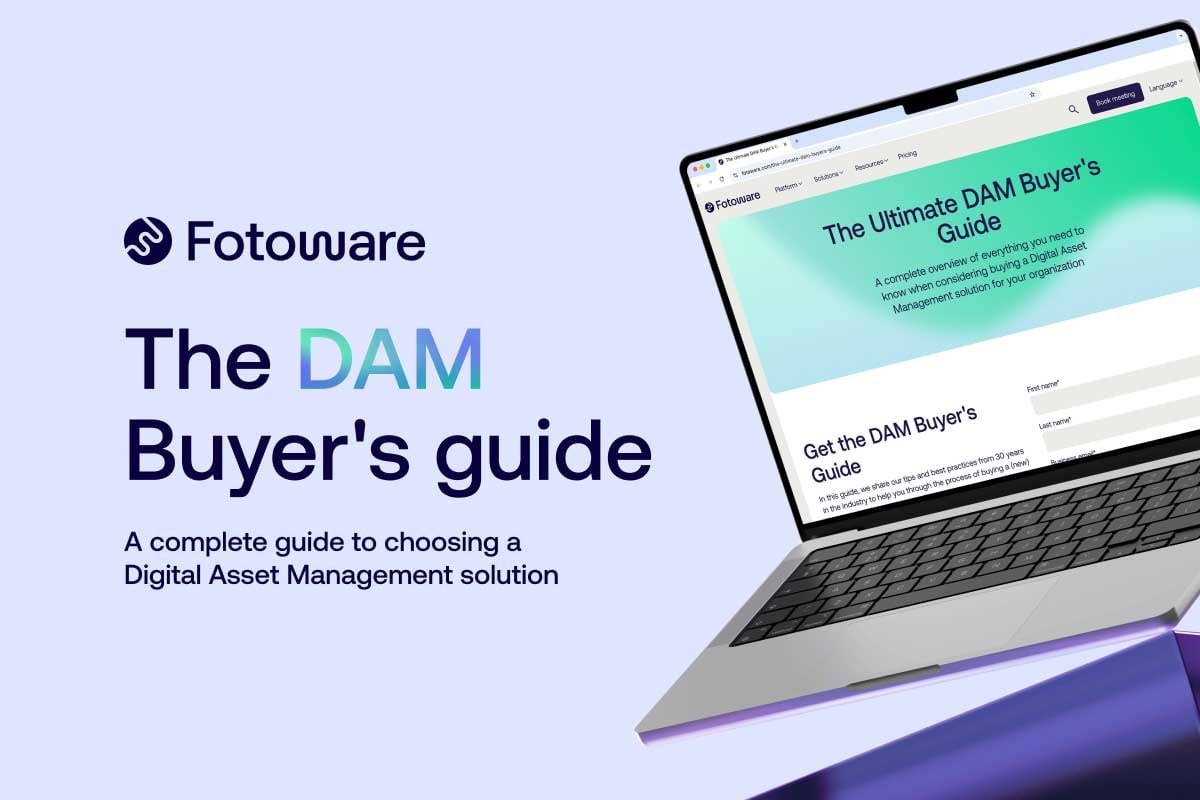
The Ultimate DAM Buyer's Guide
Learn everything you need to know when considering buying Digital Asset Management software for your organization in this free guide.

AI is the multiplier
AI is transforming what is possible in DAM. Natural language search that understands complex queries, automated tagging and rich media analysis, agentic workflows, and AI-assisted content modification are just a few examples.
But the real value is not AI alone. The real value comes from applying AI to trusted, well-governed content and metadata.
At Fotoware, we believe that metadata is the multiplier of AI value. Without trusted metadata and governance underneath, AI often accelerates noise rather than value.
The organizations that create the greatest value from AI will be those that combine intelligent technology with high-quality metadata, strong governance, and clear processes.
Security, compliance and trust are business-critical
The explosion of AI-generated content is increasing the importance of trust, authenticity, privacy, and copyright management.
At the same time, growing regulation and geopolitical discussions around data sovereignty are forcing organizations to take a much closer look at how they govern and protect their digital content.
What I find particularly interesting is that trust has moved from being a technical concern to a boardroom conversation.
According to Forbes, 91% of CEOs believe trust is essential for competing in a data-driven economy.
I believe that trend will only continue.
This means that capabilities such as consent management, rights management, audit logging, and content authenticity are no longer optional add-ons. They are becoming fundamental requirements for modern content operations.
At Fotoware, trust, governance, and compliance have been part of our DNA for decades, long before they became boardroom conversations.
What this means in practice
With more than 30 years of experience in this industry, we have learned that technology alone is not what creates value.
That is why we have framed our roadmap around three commitments: how work flows (automation across the full content lifecycle, from ingestion to rich media workflows), connectivity (API-first
architecture, standards-based interoperability, and a true ecosystem of integrations), and content trust (authenticity, consent, and compliance built directly into the workflow).
In my view, that is the DAM the market needs to navigate an era of exploding content volumes, accelerating AI adoption, and increasing demands for governance, transparency, and content trust.
Working with organizations ranging from newspapers and police forces to museums and major sporting bodies, one thing remains constant: every piece of content has a purpose, and it deserves to be found, trusted, and put to work creating value.
Looking ahead
Having worked in this industry for many years, I genuinely believe we are entering the most exciting chapter DAM has seen so far.
AI is changing how content is created. But even more importantly, it is changing how organizations must govern, validate, secure, and operationalize content at scale.
The future of DAM will not be defined by who can manage the most content. It will be defined by who can help organizations move content faster, trust it more, and create more value from it.
That's a future we're excited to help shape together with our customers, partners, and the broader DAM community.
From chaos to control with DAM
Download our OnDemand webinar and get an introduction to Fotoware Veloz.

Sources
More about Digital Asset Management
On this page